the good word groundswell

A Tech Blog on Communications, Energy, Location, Transportation and Logistics.

Search This Blog

Friday, July 29, 2016

US Interior to Test Drone GeoFence Over Wildfires

As reported by GCN: With wildfires blazing through 2 million acres in the United States so far this year, keeping drones away from firefighting aircraft has become a priority for forest managers.

Drone intrusions over wildfires more than doubled from 2014 to 2015, with 21 drones spotted, according to an Interior Department statement released July 25. Fifteen intrusions have complicated aerial firefighting efforts in California, Arizona, Utah, Nevada, Alaska, Minnesota and Montana. Several incidents have nearly resulted in collisions. The agency said it had been forced to ground some firefighting aircraft to ensure pilot safety.
Now a new prototype smartphone app provides real-time alerts and geofencing alarms to drone pilots if they approach zones where aerial firefighting operations are in progress. Interior developed the app with drone manufacturer DJI, which said the technology is similar to the real-time information on temporary flight restrictions it provides for major stadium events.
"This pilot project makes initial wildfire location data publicly available to commercial mapping providers that support [unmanned aerial system] operations, alerting drone pilots before they enter airspace over an active wildland fire," said Mark Bathrick, director of Interior's Office of Aviation Services, in the July 25 statement. "No responsible drone operator wants to endanger the lives of the men and women who work to protect them, and we believe this program, which uses the Global Positioning System to create a virtual barrier, will move us one step closer to eliminating this problem for wildfire managers." 
Officials said they developed the app with DJI, the largest maker of unmanned aerial vehicles in the United State, and two of the leading airspace intelligence and navigational services providers -- AirMap and Skyward.
The companies now receive information directly from Interior's Integrated Reporting of Wildland-Fire Information system and transmit it to drone pilots via AirMap apps and the geofencing system in DJI's GO flight control app.
Interior officials said they will incorporate what they learn from the prototype system into a "full public and industry release" of the application, planned for 2017. Future versions will "prevent drones from operating in restricted airspace once they reach a geofence perimeter."

Posted by Thomas Grounds at 10:20 AM 1 comment:
Email ThisBlogThis!Share to XShare to FacebookShare to Pinterest

Wednesday, July 27, 2016

5G Wireless Is Coming, and It’s Going to Blow You Away

As reported by MIT Technology Review: Mobile data consumption is soaring, but a broad set of technology advances is poised to transform what today’s smartphones and other wireless mobile devices can do—ushering in high-resolution video and fully immersive, 3-D environments.

At the NYU Wireless lab in Brooklyn, students are testing prototype equipment—forerunners to next-generation phones—that are able to transmit a blazing 10 gigabits of data per second, all while moving around crowded courtyards. And Samsung recently showed how a car traveling at 25 kilometers per hour could maintain a gigabit-per-second connection as the car moved in and out of range of mobile transmitters called base stations. 
Both achievements are roughly 100 times faster than what current commercial mobile phone technology can do. 
These are demonstrations of the kinds of astonishing capabilities that will be unleashed thanks to this month’s release of vast amounts of high-frequency spectrum by the U.S. Federal Communications Commission—a move that will make available several times more spectrum than has ever existed for wireless telecommunications—and a $400 million research effort announced by the White House.
The next-generation technology will eventually be defined in a standard that will be known as “5G.” It is expected to provide Internet connections at least 40 times faster—and with at least four times more coverage worldwide—than the current standard, known as 4G LTE. 
The new technology is expected to use so-called “millimeter wave” radio spectrum, or wavelengths above 24 gigahertz. The FCC’s move in mid-July made the United States the first country to make far more of this spectrum available for commercial use, as opposed to primarily for radar and military systems.
Higher-frequencies carry significantly more data. But they are also far more easily blocked by buildings, foliage, and even rain, making their use for mobile communications quite challenging (some existing systems use these frequencies for fixed point-to-point wireless connections with clear lines of sight).
This Intel chip, called a "massive antenna array," includes
64 antennas and can be expanded to 256, allowing
ultra-high-capacity millimeter-wave frequencies
to be send in specific directions.
But thanks to advances in signal processing, chips, and antenna technologies, Samsung, AT&T, Verizon, Ericsson, and other companies will be able to use this spectrum for next-generation mobile connectivity.
Already, some startups are using these tricks to pursue new business models. One is Starry, a company beta testing a home Internet access service in Boston. But such efforts are intended for stationary devices.
The NYU and other demos are showing how millimeter wave signals can be used for mobile communications and get around the biggest problem: they’re blocked by objects that come between transmitter and receiver.
Arrays of tiny antennas on chips or on miniature circuit boards can “steer” a signal in specific directions and mitigate this downside. This is known as “phased array”; Samsung, for example, has already prototyped a 32-antenna phased array in handheld wireless devices. Samsung, Ericsson, and Nokia all have equipment they are preparing for trials.
“There’s a tremendous amount of work being done at all the major telecom companies, big and small. You see a lot of good activity happening throughout the industry, realizing that the millimeter wave future is coming very, very quickly,” says Ted Rappaport, who heads wireless research at NYU.  
The first commercially available handsets with such technology could appear in two to five years. “I call this the renaissance of wireless. There is a confluence of events that will change the world much faster than anybody believed a few years ago,” Rappaport says. 
Underpinning the new wireless technologies are remarkable advances in microchips. First, the smaller feature size on chips will allow much more data processing without killing off your battery. And second, such chips are being overlaid with a second layer of materials that act as antennas, minimizing signal loss and energy consumption.
Manufacturing advances are making these advanced capabilities possible on standard silicon, paving the way for cheap consumer devices, says Ken Stewart, chief wireless technologist at Intel. “What the consumer will see are ever richer experiences and high-resolution video on mobile devices,” he says. “Instead of playing Pokémon Go while watching phone screens, they’ll be doing it in fully immersive, 3-D environments with fast refresh rates.” 
The groundswell of activity comes amid exponential growth in wireless data demands as billions of people expect more capacity in their mobile devices. Additional demand will come from machines like networked cars and smart power grids.

Posted by Thomas Grounds at 9:18 AM No comments:
Email ThisBlogThis!Share to XShare to FacebookShare to Pinterest

Tuesday, July 26, 2016

Lithium-Oxygen Battery Promises Lighter Electric Cars

As reported by Engadget: Lithium-air batteries are supposed to lead to lighter, longer-ranged electric cars thanks to their high power-to-weight output, but they have some showstopping flaws: they not only degrade rapidly, but waste a lot of energy input as heat. Neither is exactly ideal in a vehicle that's expected to last you several years and charge quickly. Scientists at MIT, Argonne National Laboratory and Peking University might have found a better way, though. They've engineered a lithium-oxygen battery that offers the light weight of lithium-air without its drawbacks.

Instead of pulling in oxygen from the air to trigger a chemical reaction, like a lithium-air battery would, this new design relies on nanoscale particles that hold both lithium and oxygen, keeping the oxygen inside as it changes states. This both dramatically reduces the energy loss (about five times less voltage) and prevents the rapid changes in volume that cut tend to shrink a battery's usable lifespan. The lithium-oxygen tech is also more friendlier to real-world conditions (lithium-air can't take carbon dioxide or moisture) and is inherently protected against overcharging -- it just shifts to a different reaction when there's too much power.

Right now, the battery exists solely as a proof of concept in a lab. However, there is a plan to create a prototype within a year. It's realistic, too, as it doesn't need expensive materials and could be used just like a run-of-the-mill lithium-ion battery. Should all go well, you could see electric cars that store twice as much energy at a given weight as lithium-ion cells. That, in turn, could lead to EVs that either end range anxiety or don't have to weigh so much to deliver the range you get today.

Posted by Thomas Grounds at 3:36 PM No comments:
Email ThisBlogThis!Share to XShare to FacebookShare to Pinterest

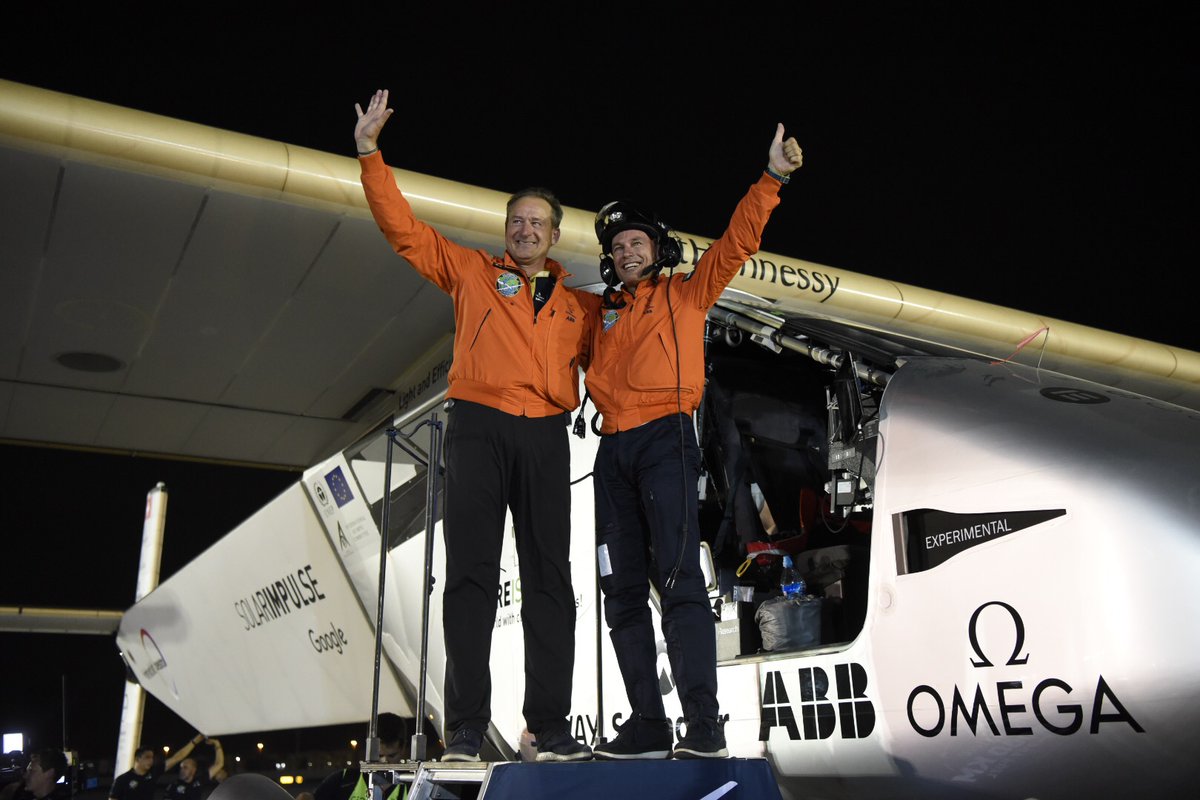
Solar Impulse Completes its Round-The-World Journey

As reported by Engadget: In March 2015 Solar Impulse 2 took off from Abu Dhabi and tonight it has successfully returned, completing a 40,000km+ round the world trip. It managed the feat "without using a drop of fuel," becoming the first to manage the feat thanks to sunlight, piloted by Bertrand Piccard and Andre Borschberg. Its arrival is a bit delayed, partially due to some problems withheat-related battery damage, but just making the trip helps the project's goal to show off the potential of transportation powered by green energy sources.

 Follow
Bertrand PICCARD 
✔@bertrandpiccard
BREAKING: it’s a first in the history of #energy, @solarimpulseis only the beginning, #futureisclean pic.twitter.com/sRjD59Gi2x
6:41 PM - 25 Jul 2016
  •  
  •  507507 Retweets
  •  
  •  514514 likes
Posted by Thomas Grounds at 8:01 AM No comments:
Email ThisBlogThis!Share to XShare to FacebookShare to Pinterest

Wednesday, July 20, 2016

Google Cuts Its Giant Electricity Bill With DeepMind-Powered AI

As reported by Bloomberg Technology: Google just paid for part of its acquisition of DeepMind in a surprising way.
The internet giant is using technology from the DeepMind artificial intelligence subsidiary for big savings on the power consumed by its data centers, according to DeepMind Co-Founder Demis Hassabis.
In recent months, the Alphabet Inc. unit put a DeepMind AI system in control of parts of its data centers to reduce power consumption by manipulating computer servers and related equipment like cooling systems. It uses a similar technique to DeepMind software that taught itself to play Atari video games, Hassabis said in an interview at a recent AI conference in New York.
The system cut power usage in the data centers by several percentage points, "which is a huge saving in terms of cost but, also, great for the environment," he said.
The savings translate into a 15 percent improvement in power usage efficiency, or PUE, Google said in a statement. PUE measures how much electricity Google uses for its computers, versus the supporting infrastructure like cooling systems.
Google said it used 4,402,836 MWh of electricity in 2014, equivalent to the average yearly consumption of about 366,903 U.S. family homes. A significant proportion of Google’s spending on electricity comes from its data centers, which support its globe-spanning web services and mobile apps.
Saving a few percentage points of electricity usage means major financial gains for Google. Typical electricity prices companies pay in the U.S. range from about $25 to $40 per MWh, according to datafrom the U.S. Energy Information Administration. (Prices in different regions range from a few dollars to more than $100). Either way, saving 10 percent on data center power consumption, for instance, could translate to hundreds of millions of dollars in savings for Google over multiple years. Google acquired DeepMind in 2014 for 400 million pounds, or more than $600 million at the time, according to The Guardian.
The application of DeepMind’s technology builds on previous efforts by Google to apply machine learning, a type of AI, to its data centers. Back in 2014, the company said it used neural networks, a type of pattern recognition system, to predict how its power usage would change over time, letting it arrange equipment in more efficient ways.
The DeepMind work goes a step further. Instead of making moves in an Atari game, the software changes how equipment runs inside the data centers to get the highest score -- in this case more efficient consumption of electricity.
"It controls about 120 variables in the data centers. The fans and the cooling systems and so on, and windows and other things," Hassabis said. "They were pretty astounded."
This is just the beginning of the project, Hassabis said. Now that DeepMind knows the approach works, it also knows where its AI system lacks information, so it may ask Google to put additional sensors into its data centers to let its software eke out even more efficiency.

Posted by Thomas Grounds at 8:45 AM No comments:
Email ThisBlogThis!Share to XShare to FacebookShare to Pinterest

Tuesday, July 19, 2016

SpaceX Will Attempt to Land Three Rockets at Once

As reported by Gizmodo: Having successfully launched and landed a few single rockets, SpaceX is now planning a simultaneous triple rocket landing. This is going to look cool.

SpaceX told The Orlando Sentinel that it’s seeking government permission for two extra landing pads in preparation for the launch of the new Falcon Heavy rocket. The private spaceflight company says that it might attempt to land its Falcon Heavy rockets on one of its drone barges—a protocol that the SpaceX has nearly perfected in the past year. Eventually, however, SpaceX wants to land three rockets on solid ground. The extra two ports SpaceX hopes to build at Cape Canaveral’s Air Force Base, where the company already has one port, would give it the real estate to do that.
When the Falcon Heavy launches, it will be the world’s most powerful rocket, beating the current title-holder, the Delta IV, with more than twice the power. The Falcon Heavy will be capable of lifting up to 54 tons of weight into space. To get that much thrust, it actually has three separate rocket cores, and that means that the company will need multiple landing pads to successfully save all three rockets. 
Musk went on Twitter to further explain that two of those rockets would land practically simultaneously, while the third would arrive after a slight delay. You can see how the process would unfold in this animation the company put together:
Three rocket landings at once certainly sounds like something to see, but Musk also went on to hint at one more landing down the road. While the rocket cores in the Falcon Heavy are designed to return, the upper stage of the rocket is not—not yet anyways. Musk tweeted:
Prob best to stay focused on the Mars rocket, indeed.


Posted by Thomas Grounds at 10:37 AM No comments:
Email ThisBlogThis!Share to XShare to FacebookShare to Pinterest

Monday, July 18, 2016

SpaceX Launches Critical Space Station Docking Port for NASA

As reported by CBSNews: A SpaceX Falcon 9 rocket roared to life and streaked into space early Monday, boosting a Dragon cargo ship into orbit loaded with nearly 5,000 pounds of equipment and supplies bound for the International Space Station, including a critical docking mechanism needed by U.S. crew capsules now under construction.

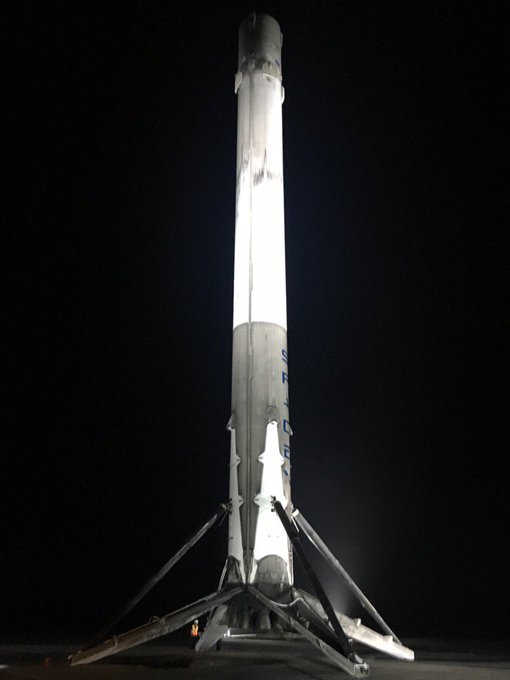
SpaceX also pulled off its fifth first-stage landing and its second touchdown at the Cape Canaveral Air Force Station. Recovering, refurbishing and eventually re-launching Falcon 9 stages is a key element in company founder Elon Musk's ongoing attempt to dramatically lower the cost of spaceflight.
Musk tweeted about it:
View image on Twitter
 Follow
Elon Musk 
✔
@elonmusk
Out on LZ-1. We just completed the post-landing inspection and all systems look good. Ready to fly again.
12:49 AM - 18 Jul 2016
  •  
  •  2,9072,907 Retweets
  •  
  •  8,0018,001 likes
But the first-stage recovery Monday was a purely secondary objective.
The mission's primary goal was to boost the SpaceX Dragon cargo ship into orbit and along with it, the long-awaited International Docking Adapter, or IDA.
The half-ton Boeing-built component will replace one that was destroyed in a June 2015 Falcon 9 launch failure and keep NASA on track for initial test flights of the new crew ferry ships in 2017 or 2018.
Also on board the Dragon: 815 pounds of food, clothing and other crew supplies, 280 pounds of spacewalk equipment, 119 pounds of Russian hardware, 617 pounds of U.S. station equipment and spare parts and a full ton of research samples and equipment, including an innovative device the size of a small candy bar to carry out the first gene sequencing in space.
"We're really interested in how this works in microgravity; it's never been done before," said astronaut Kate Rubins, a molecular biologist launched to the space station July 6. "We're going to be trying to do the first DNA sequencing in space, and it'll be a combination of a bacteria, a virus and a mouse genome that we'll be sequencing."
The MinION gene sequencer works by measuring very slight changes in electrical conductivity as DNA components pass through a biological pore. Rubins said the research she hopes to carry out will help scientists better understand the mechanisms behind bone loss, muscle atrophy and other negative aspects of living in microgravity.
"It also has a benefit for Earth-based research as well," she said. "When we do things in a remote environment up here, we can understand how these technologies might work in remote places on Earth that don't have access to good medical care," Rubins said.
Other experiments of interest aboard the Dragon include a study to determine the effects of weightlessness on microorganisms that originated in the Chernobyl nuclear disaster; a study to learn how beating heart cells are affected by weightlessness; tests of an experimental ship tracking system; and another to evaluate a new type of heat exchanger to control spacecraft temperatures.
Also on board: 12 mice that will be returned to Earth aboard the Dragon in late August. The rodents will be studied after the flight to determine how they were affected by exposure to weightlessness.
"This research cargo will support over 280 experiments," said Camille Alleyne, a space station program scientist at the Johnson Space Center in Houston. "These are in a variety of disciplines, including human research, biology and biotechnology, physical sciences, Earth and space sciences, technology demonstration and education."
The latter category includes a cache of tomato seeds that will be distributed to school kids after the flight to find out what effects, if any, might be due to time spent in weightlessness.
Putting on a dramatic overnight sky show under a nearly-full moon, the 20-story tall Falcon 9's nine first stage engines ignited with a torrent of fiery exhaust at 12:45 a.m. EDT, boosting the rocket away from pad 40 at the Cape Canaveral Air Force Station.
Liftoff came just 31 hours after launch of a Russian Progress supply ship from the Baikonur Cosmodrome in Kazakhstan that is carrying 5,800 pounds of supplies and equipment. If all goes well, the Progress MS-03/64P supply ship will reach the station Monday evening, docking at the Earth-facing Pirs module around 8:22 p.m.
The 229-foot-tall Falcon 9, generating 1.5 million pounds of thrust, initially climbed straight up from launch complex 40 and then arced away to the northeast as it thundered directly into the plane of the space station's orbit.
Spectators, including VIPs and the media, were forced to leave the nearby Kennedy Space Center an hour before liftoff because of recent modifications designed to enable the Dragon's landing parachutes to deploy in the event of a mishap that might leave the capsule -- and its valuable cargo -- intact after a booster failure.
Because forecasters predicted winds that could blow a descending capsule back toward the launch site after an in-flight accident, Air Force range safety officers ordered non-essential personnel to leave the area in case of a landing that could result in the release of toxic propellants.
But the climb away from the Cape was picture perfect. The first-stage engines burned for two minutes and 21 seconds, propelling the rocket out of the dense lower atmosphere before shutting down. A moment later, the first stage fell away and the single engine powering the second stage ignited to continue boosting the Dragon toward orbit.
The first stage, meanwhile, flipped around tail first and carried out the first of three engine firings to halt its forward velocity and begin the flight back to a landing at the Cape Canaveral Air Force Station.
Four minutes later, three of the first-stage engines re-ignited to slow the ship for descent back into the discernible atmosphere. Then, about seven-and-a-half minutes after launch, the engines fired back up a third time for landing.
Spectators in nearby Port Canaveral were treated to a spectacular show as the stage descended through a clear night sky atop a jet of fiery exhaust, deploying four landing legs and settling to a smooth touchdown on a pad known as Landing Zone 1. The landing was heralded by two sonic booms that rumbled across the Space Coast.
Going into the mission, SpaceX had made 9 attempts to land a Falcon 9 first stage, chalking up four successes: three on an off-shore "drone ship" and one at the Air Force station last December. The record now stands at five successes in 10 attempts. If all goes well, SpaceX hopes to re-launch its first used booster this fall.
While the first stage was flying back to Florida, the Falcon 9's second stage was boosting the Dragon toward space. Finally, about nine minutes and 37 seconds after liftoff, the Dragon separated from the second stage. A few minutes after that, two solar arrays unfolded and locked in place.
If all goes well, the Dragon will carry out a computer-controlled rendezvous, approaching the station from below early Wednesday. Expedition 48 commander Jeff Williams, operating the lab's robot arm, plans to latch onto the Dragon around 7 a.m. Flight controllers in Houston then will take over arm operations, moving the cargo ship into position for berthing at the forward Harmony module's Earth-facing port.

Posted by Thomas Grounds at 7:43 AM No comments:
Email ThisBlogThis!Share to XShare to FacebookShare to Pinterest
Newer Posts Older Posts Home
Subscribe to: Comments (Atom)

iTRAK Corporation - Fleet, Asset and Smartphone Tracking Telematics Systems and Solutions

  • iTRAK Corporation Web Site

The Good Word Groundswell is on Flipboard too!

  • Flipboard - The Good News Groundswell

Translate

Blog Archive

  • ▼  2022 (10)
    • ▼  August (1)
      • Did Russia Just Launch a Spacecraft to Stalk a US ...
    • ►  June (1)
    • ►  May (2)
    • ►  April (2)
    • ►  February (3)
    • ►  January (1)
  • ►  2021 (14)
    • ►  December (2)
    • ►  November (1)
    • ►  August (2)
    • ►  June (1)
    • ►  May (2)
    • ►  April (2)
    • ►  March (1)
    • ►  February (1)
    • ►  January (2)
  • ►  2020 (31)
    • ►  December (1)
    • ►  November (3)
    • ►  October (4)
    • ►  September (2)
    • ►  August (8)
    • ►  June (1)
    • ►  May (2)
    • ►  April (2)
    • ►  March (1)
    • ►  February (4)
    • ►  January (3)
  • ►  2019 (21)
    • ►  December (2)
    • ►  November (1)
    • ►  September (3)
    • ►  July (4)
    • ►  June (7)
    • ►  May (1)
    • ►  April (1)
    • ►  January (2)
  • ►  2018 (22)
    • ►  October (4)
    • ►  June (5)
    • ►  February (5)
    • ►  January (8)
  • ►  2017 (138)
    • ►  December (8)
    • ►  November (18)
    • ►  October (20)
    • ►  September (15)
    • ►  August (16)
    • ►  July (16)
    • ►  June (12)
    • ►  May (5)
    • ►  April (8)
    • ►  March (9)
    • ►  February (3)
    • ►  January (8)
  • ►  2016 (172)
    • ►  December (6)
    • ►  November (5)
    • ►  October (11)
    • ►  September (8)
    • ►  August (13)
    • ►  July (12)
    • ►  June (23)
    • ►  May (20)
    • ►  April (11)
    • ►  March (17)
    • ►  February (22)
    • ►  January (24)
  • ►  2015 (420)
    • ►  December (25)
    • ►  November (26)
    • ►  October (40)
    • ►  September (22)
    • ►  August (32)
    • ►  July (41)
    • ►  June (40)
    • ►  May (30)
    • ►  April (36)
    • ►  March (45)
    • ►  February (36)
    • ►  January (47)
  • ►  2014 (503)
    • ►  December (33)
    • ►  November (27)
    • ►  October (27)
    • ►  September (23)
    • ►  August (46)
    • ►  July (35)
    • ►  June (35)
    • ►  May (66)
    • ►  April (59)
    • ►  March (52)
    • ►  February (45)
    • ►  January (55)
  • ►  2013 (376)
    • ►  December (44)
    • ►  November (37)
    • ►  October (44)
    • ►  September (96)
    • ►  August (81)
    • ►  July (37)
    • ►  June (23)
    • ►  May (14)

About Me

Thomas Grounds
View my complete profile
  • iTRAK Facebook
  • iTRAK Linked-In
  • iTRAK YouTube
  • iTRAK Corporation
  • Tom's Twitter
  • Tom's Linked-In
  • Tom's Google+ site
Awesome Inc. theme. Theme images by Dizzo. Powered by Blogger.