Russian border guards near Kaliningrad “detained” a low-flying drone entering the country from Lithuania last week. According to a spokesperson for Russia’s Federal Security Service (FSB), it wasn’t on a spy mission—it was smuggling cigarettes.
The autonomous aircraft, which had a four-meter (13-foot) wingspan, flew close to the ground following GPS waypoints and released cigarette cartons from its cargo bay at designated drop zones. When captured, it was carrying 10 kilograms (about 22 pounds) of illicit cargo.
FSB press service chief Oleg Dzhurayev told the ITAR-TASS news service that the drone was built by a criminal organization operating in Russia and Lithuania, and it may have been used for other smuggling operations. Dzhurayev added that this was the first time Russian authorities have captured a foreign drone in the Kaliningrad region, a Russian “exclave” between Lithuania and Poland on the Baltic Sea.
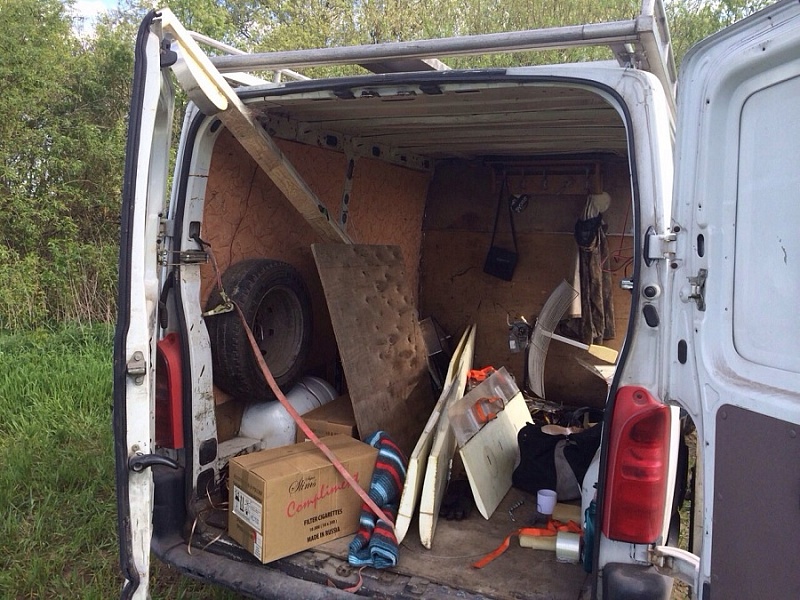
Update:According to areport from NewKaliningrad.ru, the members of the smuggling ring operating the drone have been arrested—and while it was built in Lithuania, the cigarettes were actually being smuggled to Lithuania from Russia. A 31-year old Lithuanian man had crossed the border legally, and met with a 51-year old Kaliningrad region resident, who helped him buy cigarettes to smuggle to Lithuania. The drone was essentially a set of wings on a skeleton of a fuselage, to which the boxes of cigarettes were strapped externally, as shown in the photos above and below:
Enlarge/The naked drone—a home-made system with radio and GPS control.
The FSB spokesman said that it was estimated that the body of the drone cost about 300 rubles—about $10 dollars. "The appearance of it is unpresentable, but if the plane was made for criminal activity, so there is no reason to make him some kind of supermodel," said Dzhurayev. "And the main thing here is its filling. Due to the design it can lift up to 10 kilograms of cargo. Additionally, the unit could conduct surveillance, was equipped with a camera and had an automatic flight route which is set in advance." The 500 packs of contraband cigarettes were worth about 25,000 rubles in Russia—around $700—but cigarettes sell for $4 or more a pack in Lithuania, so the haul could have yielded as much as a $1,300 profit per flight.
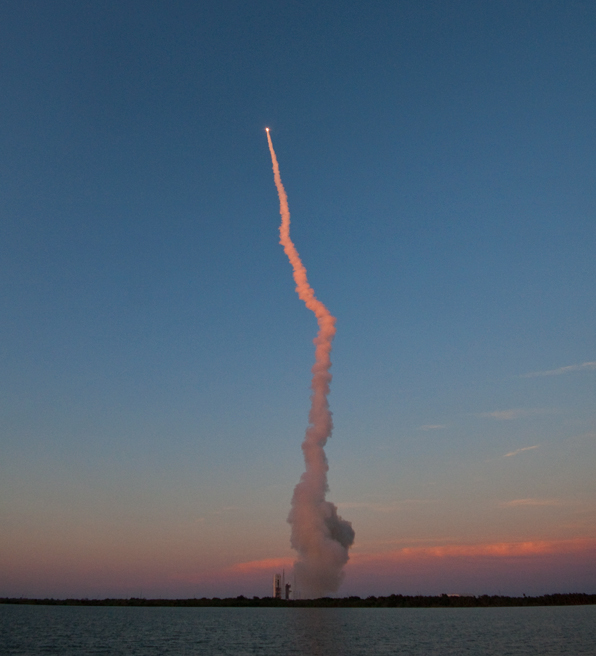
As reported by Space.com: A replacement Global Positioning System spacecraft for the world's
best-known satellite constellation ascended into orbit Friday (May 16)
night aboard a Delta 4 rocket in a spectacular sendoff at sunset.
Igniting its main engine and twin solid rockets at 8:03 p.m. EDT, the
205-foot-tall vehicle lifted off on 1.2 million pounds of chest-thumping
thrust. The launch had been delayed a day by inclement weather.
Arcing to the northeast, the Delta 4 accelerated through Mach 1 in less
than a minute, jettisoned its strap-on boosters a minute later and
cruised out to staging in four minutes. The cryogenic upper stage then lit to propel the vehicle into a
transfer orbit, reaching the point of engine cutoff over the North
Atlantic 15 minutes into flight.
A three-hour coast then began as the rocket flew over Europe, the
Middle East and Indian Ocean before restarting the RL10B-2 engine to
circularize the orbit at 11,000 nautical miles and tilted 55 degrees to
the equator. "Our team has launched every modern GPS satellite from here at Cape Canaveral Air Force Station. We take great pride in our ability to deliver these capabilities
to our citizens and warfighters," said Lt. Col. Paul Konyha, 45th
Launch Support Squadron commander. "I am always impressed by the amount
of dedication and rigor that everyone puts into each launch."
It was a direct insertion ascent, putting the $245 million Global
Positioning System 2F-6 payload into the navigation network three hours
and 15 minutes after blastoff.
"Today's successful launch demonstrates our combined government and industry team's dedication to mission success,
ensuring GPS continues to be the Gold Standard for space based
positioning, navigation, and timing," said Col. Bill Cooley, director of
the Space and Missile Systems Centers Global Positioning Systems
Directorate. "I want to recognize the tireless efforts of the 45th and 50th Space wings, United Launch Alliance, Boeing, and the GPS 2F and Delta 4 program teams at SMC. I am extremely proud of the team, everyone pulled together to make this day a true success. Users can depend on GPS with confidence today, tomorrow and in the future."
GPS 2F-6 will replace the aging spacecraft known as GPS 2A-23 in Plane
D, Slot 4 of the constellation. The GPS 2A-23 satellite was launched
aboard Delta 223 in October 1993. It will go into a reserve role in the
network for the remainder of its useful life.
"The replacement of our legacy satellites ensures both the sustainment
and the modernization of the GPS constellation by providing the increase
in signal power, improved accuracy and anti-jamming capabilities for GPS users worldwide," said Col. Steve Steiner, GPS Space Systems Division chief.
This was the sixth of 12 Boeing-built Block 2F spacecraft being
manufactured to form the backbone of the GPS fleet for the next 15
years. The full dozen satellites are due to be launched by mid-2016.
"Boeing's dedicated
GPS team is proud and excited to reach this half-way point in
delivering this new-generation of spacecraft into service," said Munzir
Badawi, Boeing's GPS 2F program manager.
It was the second GPS launch since February, with two more planned for the end of July and late October aboard Atlas 5 rockets from the Cape to further bolster the constellation.
"Boeing has continued to maintain a robust tempo of deliveries to meet
U.S. Air Force requirements, with the next GPS 2F already on deck in
Florida for a third-quarter liftoff," said Craig Cooning, vice president
and general manager of Space and Intelligence Systems. "As a prime
contractor on the GPS program since the first launch in 1978, our
experience with these complex and critically important spacecraft spans
nearly 40 years and now covers 44 satellites delivered into orbit with
continuing mission support." The current constellation is comprised of seven GPS 2A satellites, a
dozen GPS 2Rs, seven 2R-Ms and four GPS 2Fs. The one launched in
February is nearing completion of a navigation characterizing testing
and will become the 31st member of the constellation by month's end. GPS 2F-6 will replace its target within a month of launch.
"The GPS constellation is reliably serving global users with the most
accurate and robust signals ever, and the navigation, timing accuracy
and availability will improve as the GPS modernization efforts
continue," said Col. Bill Cooley, director of the Space and Missile
Systems Center's Global Positioning Systems Directorate.
The next Delta 4 launch is scheduled for July 23 carrying two
satellites for the Air Force's Geosynchronous Space Situational
Awareness Program.
The next launch from Cape Canaveral is less than a week away. An Atlas 5
will launch a classified National Reconnaissance Office payload next
Thursday morning between 8:45 and 10:15 a.m. EDT.
As reported by Aerospace Technology: E-Fan, a two-seat experimental electric aircraft
developed by Airbus Group and partners, was unveiled and made its first
public flight demonstration at Bordeaux-Mérignac Airport in France in
April 2014. The training aircraft is intended for flying clubs and
schools, and can be used for training professional pilots. Flight
tests on the E-Fan 2.0 prototype are currently underway, while
development of the production version is expected to begin in June in a
production facility near Bordeaux Airport. BpiFrance Public Investment
Bank will partially provide finance for the development. The aircraft is
expected to enter into service by 2017. Airbus plans to introduce a new four-seat E-Fan 4.0 version aircraft in the next two years. Design features of E-Fan aircraft The
E-Fan aircraft design was initiated in late 2011 and the final go-ahead
for the E-Fan demonstrator development was obtained in October 2012.
The electric aircraft features an all-composite construction using
materials provided by French company Aéro Composite Saintonge (ACS). It
also includes a pyrotechnically deployed airframe parachute rescue
system. The aircraft is designed to meet flight training and aeroclub
requirements, considering hangar parking space and flight endurance
criteria. The design is also aimed to meet the emission standards set in
the European Commission report, 'Flightpath 2050 - Europe's Vision for
Aviation'. The report set the targets in comparison to the standards of
the year 2000, which include reducing the aircraft's carbon dioxide
emissions by 75%, nitrous oxide emissions by 90% and noise levels by
65%. Video cameras are fitted in the aircraft to provide safety,
maintain contact with the pilot and monitor flight parameters. The
aircraft external dimensions include a length of 6.67m and a wingspan of
9.5m. Landing gear The E-Fan aircraft's landing gear
consists of two electrically actuated retractable wheels positioned
fore and aft below the fuselage. It also includes two small wheels under
the wings. The aft main wheel includes an electric motor with 6kW
power, which provides taxiing and acceleration up to 60km/h during
take-off. It is designed to provide reduced overall electrical power
consumption during the operation. Propulsion of the E-Fan electric aircraft The aircraft is powered by two electric motors with a collective
power of 60kW. Two ducted fans enhance the static thrust, reduce the
perceived noise and improve the safety on the ground. The electric
motors of the aircraft are powered by 250V lithium-ion polymer batteries
manufactured by KOKAM. The aircraft includes 120 cells lithium
polymer battery system with a rated capacity of 4V per cell in addition
to a backup battery for emergency landing purposes. The battery packs
are located in the wings of the aircraft and can be recharged in one
hour. The aircraft is also equipped with a telemetry system, which
records all propulsion, battery and engine parameters and transmits
them to a ground station. Performance The E-Fan aircraft
has a take-off speed of 110km/h, cruise speed of 160km/h and maximum
speed of 220km/h. Its endurance ranges between 45 minutes and one hour. Partners and suppliers involved with the development of the E-Fan The
E-Fan aircraft was developed by Airbus Group in association with other
consortium partners. The core development team consisted of ACS, EADS
Innovation Works, Astrium, Eurocopter (now part of Airbus Group). EADS
Innovation Works provided the overall project management and overall
aircraft energy management system, while ACS provided support in the
construction of all composite parts and mechanical assembly of the
landing gear and flight controls. Institut Pprime provided support
for the design of the aircraft main spar and the wing. A3IP provided
design, routing, prototyping and manufacture support in the production
of tailor-made printed circuit boards for electrical networks. RF Tronic
Ingénierie provided design and integration of the air-to-ground
telemetry system and the flight data recorder, and also developed a
software to display the technical flight parameters. C3
Technologies provided spars and wings, while MAPAERO Aerospace Coatings
provided high-quality paint for the aircraft. The propulsion systems
were provided by Safran, Snecma, Labinal Power Systems and Aircelle.
As reported by Green Car Reports: In the search for better electric-car batteries, lots of lab research has to happen before anything can be announced. A company called Power Japan Plus came out of stealth mode to unveil a new battery chemistry, with both electrodes--anode and cathode--made of carbon. The new cell, known as the Ryden Dual-Carbon Battery, promises energy
density equal to today's lithium-ion cells, but less capacity loss over
time and far greater safety.
Dual-Carbon Battery vs Lithium-Ion Battery
Same energy, longer life, safer, recyclable It is also almost entirely recyclable, with less energy input over
its lifetime--and none of the rare or heavy metals required in various
lithium-ion cell chemistries. Dual-carbon cells have been described in theory since at least 1978,
but years of development were required to make them reliable,
cost-effective, and suitable for mass production in high volumes, Power Japan Plus CEO Dou Kani told Green Car Reports. The breakthroughs in chemistry were achieved by chief technology
officer Kaname Takeya and Dr. Tatsumi Ishihara of Kyushu University in
Fukuoka, Japan, which partnered with the company to develop the cell for
commercial applications. While they cannot provide details due to multiple pending patents,
Takeya said that the chemistry requires specific and proprietary changes
to the nanostructure of the carbon crystals. While Power Japan cannot disclose its first customer today, CEO Kani
said, it will announce a partner in August, that will build battery
packs and add a battery-management system.
Energy capacity over cycle life: Power Japan Plus
What electric cars need to succeed? The company isn't holding back the hyperbole. “The Ryden dual-carbon battery is the energy storage breakthrough
needed," said CEO Kani, "to bring green technology like electric vehicles to [the] mass market.” With energy density comparable to lithium-ion, the company claims
that its Ryden dual-carbon chemistry can both recharge up to 20 times as
fast and deliver more than 4 Volts of power from a single cell. In testing, the cell has completed more than 3,000 charge/discharge
cycles with virtually no performance degradation, meaning that it could
conceivably last the lifetime of a car. Power Japan says a Ryden cell barely heats up during charge and
discharge--it "experiences minimal thermal change"--vastly reducing the
risk of thermal runaway that can lead to explosion and fires.
Energy capacity over cycle life: Power Japan Plus
In other words, an electric car's battery would hold its full energy
over 10 years or more, and could be discharged right down to 0 percent
of capacity without damage.
New chemistry, same production process And equally important for practicality, the new dual-carbon anode and
cathode can both be produced by existing cell manufacturing
processes--and require essentially just a single material as input:
carbon. That reduces the number of materials that must be procured for the supply chain, simplifying the entire production process. Power Japan Plus says it will start production of Ryden cells in the
18650 "commodity cell" format later this year at its small production
facility in Okinawa, Japan. Satellites first Those cells will be intended for low-volume specialty markets,
including satellite and medical-device energy storage--in volumes of 500
to 5,000 cells per month. For higher-volume production intended for other markets--including
plug-in electric cars--the company will license its technology and
consult with existing battery makers to enable them to produce the anode
and cathode materials in their own facilities. The next announcement will be a partnership with a "world-renowned
company" in the auto racing field, which will build packs and complete
battery systems, test them, and offer them in the market.
Comblex carbon made from organic cotton - Power Japan Plus
Separate from the announcement of the Ryden battery, Power Japan Plus
is also working on a new form of carbon that is entirely organic. The material, known as Carbon Complex, which is made using
naturally-grown organic cotton that is then processed using special
techniques to control the size of the carbon crystals formed during
production. Early test cells are not produced with the organic carbon, but the
company's goal is to create a battery cell that is not only competitive
with today's lithium-ion cells but uses entirely organic input materials
that can be fully recycled at the end of their life. Meanwhile, Power Japan Plus--which has been internally funded until now--is seeking its first investments of private funds. And, we suspect, car
companies all over the globe will already be making plans to acquire
some of the earliest Ryden dual-carbon cells to see if they hold up to
the company's claims under independent testing. Lithium-ion cells are likely to remain the default battery chemistry for electric cars at least through the end of the decade. But the Power Japan Plus announcement--along with other potentially
promising advances in lithium-air cells and other advanced
chemistries--show the vital importance of battery technology to the
future of transportation.
As reported by American Surveyor: May 15, 2014 - Recently, many GPS users have reported intermittent GPS
outages in their devices. After investigating, the U.S. government has
linked the problem to flawed processing of GPS satellite data within
certain GPS receiver chipsets. The GPS satellite service continues to
function as designed and is fully operational and available worldwide.
The problem affects only user equipment that erroneously ignores the
satellite health status information broadcast from every GPS satellite.
The problem is not related to the April 28, 2014, activation of civil
navigation messages on the GPS L2C and L5 signals.
Since March 15, 2014, the Air Force has been conducting functional
checkout on a GPS satellite, designated Space Vehicle Number (SVN) 64.
SVN 64 broadcasts a data message that clearly indicates SVN 64 is
unusable for navigation. Nevertheless, the U.S. government has confirmed
that certain GPS receivers are using data from SVN 64, in violation of
GPS interface specifications, resulting in outages or corrupted,
inaccurate position calculations.
The Air Force testing is scheduled to end in mid-May 2014 at which time
SVN 64 will begin normal operation. At that point, these problems may
stop occurring. Meanwhile, the U.S. government urges all GPS device
makers to review their products for compliance with the GPS interface
specifications, and if necessary, to issue software/firmware updates to
users as soon as possible. View specifications http://www.gps.gov/technical/icwg/
Users experiencing GPS outages should check with their device
manufacturers for available software/firmware updates. In addition, any
civil user seeing unusual behavior in GPS user equipment should report
it to the U.S. Coast Guard Navigation Center (NAVCEN). Aviation users
should file reports consistent with FAA-approved procedures. Military
users seeing unusual behavior should report it the GPS Operations Center
(GPSOC).
As reported by RT: A Russian Proton-M rocket with an advanced satellite on board crashed
outside of Kazakhstan's territory on Friday, about nine minutes after
lift-off. The Express-AM4R would have been Russia’s most advanced and
powerful satellite.
The crash was likely caused by a failure in one of the third
stage’s steering engines, reported Oleg Ostapenko, the head of
the Russian national space agency Roscosmos.
“The exact cause is hard to establish immediately, we will be
studying the telemetry. Preliminary information points to an
emergency pressure drop in a steering engine of the third stage
of the rocket,” he said.
Fragments of the rocket and its cargo have apparently burned in
the atmosphere, he added, which means they could not cause any
damage on the ground.
The launch went abnormal on the 540th second of the flight, when
an emergency engines shutdown kicked in in response to the rocket
deviating from its intended trajectory, the Russian Federal Space
Agency reported after the crash. The third stage, which is called
Briz-M, was approximately 150km above the ground at that moment
and had some 40 seconds to go before deploying its payload into
the orbit.
Commenting on the failed launch, Vice Prime Minister Dmitry
Rogozin said “the only way to cut down the accident rate is
to coherently implement the decision we have taken on the reform
of the space industry.”
All other launches of Proton-type rockets will be halted at
Baikonur space center in Kazakhstan until the reason for the
crash is determined.
A special commission from the Russian Federal Space Agency will
be in charge of investigating the causes of the crash. A separate
internal probe has been launched by the Voronezh mechanic plant,
the producer of the engines for Briz-M third stages.
The launch, including the equipment and possible damage to third
parties, had been insured with Ingosstrakh, the company said in a
statement. The coverage may amount to up to $225 billion.
The Proton-M rocket, carrying an advanced Express-AM4R satellite,
was launched on schedule from Baikonur on Friday. The
Express-AM4R would have been Russia’s most advanced and powerful
satellite. Ironically, it was of the same design as the
Express-AM4, which was lost in August 2011 in a failed launch.
“The spacecraft was ensured. But the time spent to produce it
cannot be reimbursed,” lamented the head of the Russian
Telecommunications Agency Oleg Dukhovnitsky. “The satellite
was ready to work; it’s the rocket that failed.”
He added that the loss would not result in deterioration of
service quality.
The spacecraft weighed 5.8 metric tons and had 63 transponders
providing X-band, C-band, S-band, L-band, Ku-band, and Ka-band
capacity along with 10 antennas installed.
The satellite was to provide internet access in Russia’s remote
regions at affordable prices. This was Russia's third launch of
Express series satellites this year. In March, Express-AT1 and
Express-AT satellites were put into orbit.
In 2013, Russia carried out 32 of the 82 space launches completed
worldwide, only one of which failed, Interfax reported.
As reported by The Daily Mail UK: UK scientists say they are three to five years away from creating a
new navigation system that would not rely on space-based technologies. A
“quantum compass” might replace the US’s widely-used GPS, first in
military and then on smartphones. The British Ministry of Defense is investing millions of pounds
into the “earth-based” technology, which they hope may become an
alternative to space-based GPS on board nuclear submarines and
ships.
Part of the reason the MoD is so keen to develop a “quantum
compass” is that GPS doesn't work underwater.
When submarines dive they navigate using accelerometers to
register every twist and turn of the vessel. However, this method
is not very accurate.
“Today, if a submarine goes a day without a GPS fix we’ll
have a navigation drift of the order of a kilometer when it
surfaces,” says Neil Stansfield from the UK Defense Science
and Technology Laboratory (DSTL) at Porton Down that is working
on the project.
Eventually, a “quantum compass” might be available for smartphone
users who now use GPS to pinpoint their location. The DSTL’s team was inspired by the Nobel-prize winning discovery
that revealed that lasers can trap and cool a cloud of atoms
placed in a vacuum to less than a millionth of a degree above
absolute zero, to temperatures a billion times colder than outer
space. At their lowest energies, the atoms become the coldest known
bodies in the universe. Super-cooled low energy atoms are
extremely sensitive to changes in the Earth’s magnetic and
gravitational field.
If trapped on a small device, their fluctuations can allow
scientists to track their movements from great distances away and
their locations pinpointed with extreme precision.
So far, the Defense Science and Technology Laboratory has
developed a quantum navigation system resembling a
“1-meter-long shoe box,” according to Stansfield.
Scientists are now focusing their efforts on miniaturizing the
device, so that it can be used by soldiers and not just on board
submarines and ships.
“Quantum TNS [Time, Navigation and Sensing] technologies
could bring game-changing advantages to the UK defense sector and
support markets measured in billions of pounds, here in the UK
and around the world,” Stansfield said.
Unlike GPS, the pioneer in the field of pinpointing locations, a
“quantum compass” will be interference-proof. The US has
repeatedly warned that its GPS is vulnerable to attacks and deliberate disruption.
A “quantum compass,” may also be used to create the world's most
accurate atomic clocks, scientists say.
In 2013, the UK announced an investment of £270 million ($453.3 million) over five
years to research the possibility of incorporating quantum
science in new products and services, the Financial Times
reports. According to the newspaper, companies including Nokia,
Hitachi and Toshiba have established quantum research
laboratories in Britain. In related news, European robins may maintain quantum entanglement in their eyes a full 20 microseconds longer than the best
laboratory systems, say physicists investigating how birds may use
quantum effects to “see” Earth’s magnetic field. It’s been proposed that
birds’ eyes contain entanglement-based compasses. Conclusive proof doesn't yet exist, but multiple lines of evidence
suggest it. Findings like this one underscore just how sophisticated
those compasses may be. “How can a living system have evolved to protect a quantum state as
well — no, better — than we can do in the lab with these exotic
molecules?” asked quantum physicist Simon Benjamin of Oxford University and the National University of Singapore, a co-author of the new study. “That really is an amazing thing.” Many animals — including not only birds, but some mammals, fish,
reptiles, even crustaceans and insects — navigate by sensing the
direction of Earth’s magnetic field. Physicist Klaus Schulten
of the University of Illinois at Urbana-Champaign proposed in the late
1970s that bird navigation relied on some geomagnetically sensitive,
as-yet-unknown biochemical reaction taking place in their eyes. Research since then has revealed the existence of special optical cells containing a protein called cryptochrome.
When a photon enters the eye, it hits cryptochrome, giving a boost of
energy to electrons that exist in a state of quantum entanglement. One of the electrons migrates a few nanometers away, where it feels a
slightly different magnetic field than its partner. Depending on how
the magnetic field alters the electron’s spin, different chemical
reactions are produced. In theory, the products of many such reactions
across a bird’s eye could create a picture of Earth’s magnetic field as a
varying pattern of light and dark.