Search This Blog

Friday, July 10, 2015

NASA Announces Astronauts Chosen for Boeing, SpaceX ISS Flights

As reported by IBT: NASA announced on 9 July that four astronauts had been selected to train for launch on the new commercial crew capsules built by Boeing and SpaceX enrollee to the International Space Station (ISS) beginning in 2017.

"I am pleased to announce four American space pioneers have been selected to be the first astronauts to train to fly to space on commercial crew vehicles, all part of our ambitious plan to return space launches to US soil, create good-paying American jobs and advance our goal of sending humans farther into the solar system than ever before," NASA Administrator Charles Bolden said in a statement.

Bolden continued, "These distinguished, veteran astronauts are blazing a new trail — a trail that will one day land them in the history books and Americans on the surface of Mars."

The four astronauts selected are Robert Behnken, Eric Boe, Douglas Hurley and Sunita Williams. The astronauts will be working with Boeing and SpaceX to develop crew transportation systems and provide crew transportation services to and from the Iss, the statement said.

According to CBS News, Behnken said, "It's really been the dream of all of us to participate in the test of a new vehicle, and a vehicle like a spacecraft is probably the gem, if you will, of a career...I would have been embarrassed as a test pilot school graduate to not have jumped at the opportunity, if it was offered to me, to fly a new spacecraft. Hopefully, I'll get that chance soon."

Hurley added, "To be part of a new test program ... is extremely exciting. The challenge from a test pilot perspective is great, and I'm just looking forward to (getting) from today all the way up to the space station."

Popular Mechanics reported that Behnken flew on two shuttle missions and trains as a rescue crew member in case STS-125 experienced any problems while servicing Hubble. Boe and Hurley also flew on two shuttle missions. Meanwhile, Williams flew on shuttle mission STS-116 on a 192 day stay to the ISS in 2006 and would return to the space station in 2012.

John Elbon, the vice president and general manager of Boeing's Space Exploration, congratulated the four astronauts on their selection. "Congratulations to Bob, Eric, Doug and Sunita and welcome to the Commercial Crew team. We look forward to working with such a highly-skilled and experienced group of Nasa astronauts as we carve a path forward to launch in 2017."
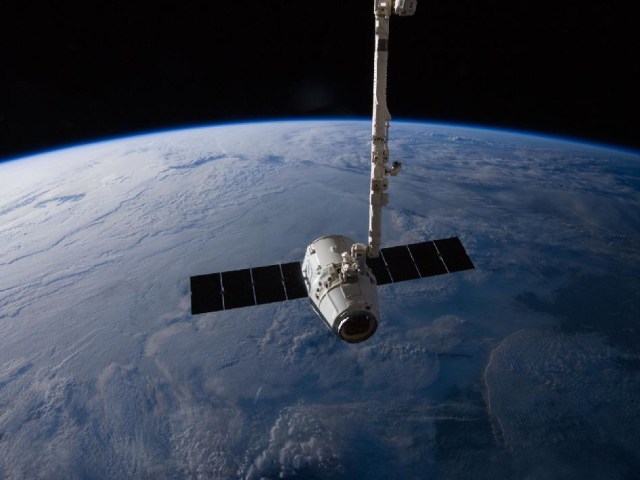
President and COO of SpaceX Gwynne Shotwell added, "We look forward to working with them even more closely as we prepare for the first human missions to the space station on Crew Dragon. Human spaceflight is why SpaceX was founded, and we look forward to supporting our nation's exploration efforts by launching astronauts from America again."

CBS News reported that Boeing holds a $4.2B (£2.7b) contract with NASA to develop the CST-100 capsule, which can carry at least four astronauts and will be launched on top of a United Launch Alliance Atlas 5 rocket.

Similarly, SpaceX holds a $2.6B (£1.6b) contract to build a human-rated version of the Dragon capsule used to deliver cargo to the ISS. The pilot version of the Dragon will carry at least four astronauts and fly atop the Falcon 9 rocket.

Iowa Makes a Bold Admission: We Need Fewer Roads

As reported by CityLabPer capita driving has peaked in America, and with that new normal comes the question of whether or not we should be spending limited transportation funding on building new roads. If nothing else the driving trends support the wisdom of a “fix-it-first” policy that focuses on highway maintenance over expansion.

Iowa DOT chief Paul Trombino recently took that logical conclusion one step further. During an Urban Land Institute talk, Trombino told the audience he expects the state’s overbuilt and unsustainable road network to “shrink,”according to Charles Marohn of Strong Towns. Iowans should figure out which roads “we really want to keep” and let the others “deteriorate and go away.”

The key quotes, via Marohn (our emphasis):
I said the numbers before. 114,000 lane miles, 25,000 bridges, 4,000 miles of rail. I said this a lot in my conversation when we were talking about fuel tax increases. It’s not affordable. Nobody’s going to pay.  We are. We’re the ones. Look in the mirror. We’re not going to pay to rebuild that entire system.  And my personal belief is that the entire system is unneeded. And so the reality is, the system is going to shrink.
Marohn characterizes the admission as a stunning one, and indeed it’s not everyday a U.S. transportation leader calls for fewer highways. But Trombino’s assessment is also spot on.

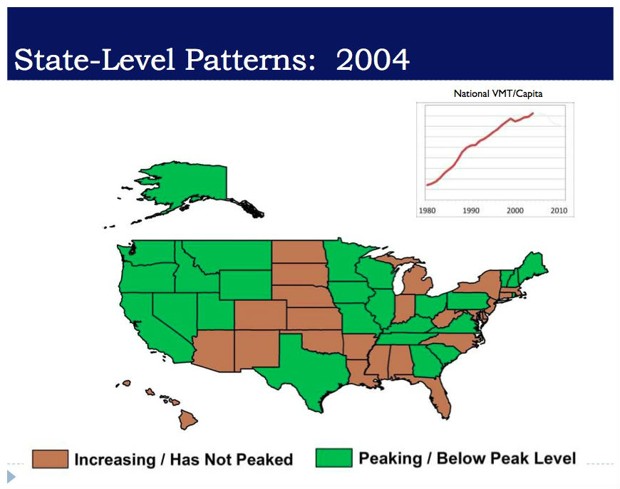
Iowa’s road network is already as big as it needs to be. Per capita driving peaked in the state in 2004 and has since been on the decline. Yet from 2009 to 2011 the state still spent 52 percent of its highway money on expansion. No surprise, then, that its share of roads in “good” condition fell from an already low 39 percent in 2008 to a frightful 21 percent by 2011. Iowa spends about $217 million a year on road repair, but Smart Growth America estimates that to get its roads into decent shape it needs to spend closer to $555 million a year over the next 20 years.


Iowa and Ohio are two states where vehicle mileage had peaked by 2004. (Via Timothy Garceau)

Trombino might be more candid about the problem than most officials, but others have recognized it. Last year the Washington State DOT made a severe adjustment to its vehicle mileage outlook in the coming decades based on a recognition that driving trends weren’t growing as they had in the past. Instead of expected continued gradual growth, WashDOT instead called for 0.4 percent growth through 2019 then a 0.4 percent decline through 2043.


Via Sightline

Cash-strapped metro areas have started to urge their state DOTs to make similar realizations about driving trends. In Ohio, where vehicle mileage also peaked around 2004, a number of metropolitan planning organizations have pushed for a new policy toward highways that focuses on maintenance over expansion, Streetblog’s Angie Schmitt reported in April. For some of these places, letting the road network shrink, as Iowa proposes, might be the wisest option.

Thursday, July 9, 2015

SpaceX Has Time on its Side to Demonstrate Readiness for GPS Launch

As reported by the SpaceFlight NowSunday’s Falcon 9 rocket failure may have blemished SpaceX’s success record, but the mishap will not keep the entrepreneurial space company from competing for U.S. military launch contracts with rival United Launch Alliance, according to an Air Force general.

SpaceX won certification from the Air Force in May to haul up sensitive and costly military satellites, and Pentagon officials announced it would accept bids from ULA and SpaceX this year for the right to launch a future GPS navigation satellite. The GPS mission is the first competitive procurement for a U.S. national security launch in more than a decade.
The Air Force said in May a specific satellite for the competition was not yet identified, but it would be one of the military’s next-generation GPS 3 navigation payloads. The initial three GPS 3 launches, expected to begin in 2017, have already been assigned to ULA’s Atlas 5 and Delta 4 rockets.
The GPS 3 launch procurement is the first of nine launch opportunities the Pentagon plans to open for bids through 2017, a set of missions the Air Force calls “Phase 1A” in the service’s effort to foster competition in the launch market.
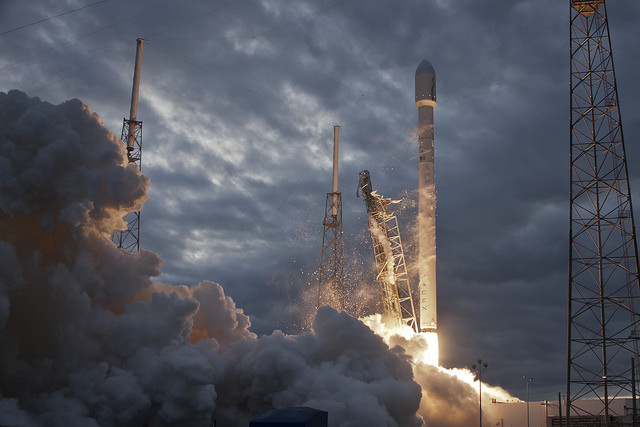
File photo of a previous Falcon 9 launch. Credit: SpaceX“SpaceX remains certified and can compete for the upcoming GPS 3 launch services,” said Lt. Gen. Samuel Greaves, commander of the Air Force’s Space and Missile Systems Center. “This anomaly does not change the Air Force plans or timelines for the Phase 1A competitions. The Air Force will continue to objectively review all proposal submissions for launch services against the criteria in the relevant solicitation.”
The Air Force announced May 26 that SpaceX received certification for national security space launches, ending a nearly two-year process involving flight data reviews, engineering analyses and financial audits. The Air Force said it approved the Falcon 9 rocket for launch competitions based on the booster’s flight history, before completing all the milestones outlined in a 2013 agreement that laid the framework for certification.
The Falcon 9 v1.1 rocket configuration, which SpaceX intended to bid for Air Force missions, achieved 13 straight successful flights before Sunday’s failure.
SpaceX officials criticized the length of the Pentagon’s certification review, and the California rocket company filed a lawsuit against the Air Force in April 2014 after the Defense Department awarded a sole-source $11 billion contract to ULA for 36 Atlas and Delta rocket cores. The hardware will cover 28 launches.
The Air Force claimed the bulk purchase of launches from ULA saved the service more than $4 billion compared to cost projections from 2012. SpaceX says it can save the Air Force even more money by launching its satellites at less cost than ULA.
SpaceX and the Air Force settled the lawsuit in January, keeping the ULA block buy intact as the military promised to certify the Falcon 9 rocket by mid-2015.
Greaves said the Air Force was invited to participate in the investigation into Sunday’s failure. Because the launch was a commercial flight, SpaceX is leading the inquiry under the oversight of the Federal Aviation Administration. NASA and the Air Force are supporting SpaceX.
SpaceX’s Falcon 9 and ULA’s Atlas 5 and Delta 4 rockets are currently the only launchers certified for the military’s most expensive payloads, which include clandestine spy satellites for the National Reconnaissance Office, missile warning platforms, nuclear-hardened communications craft, and GPS navigation spacecraft, which are vital for many military and civilian applications.
The Falcon Heavy will go through its own certification reviews after completing three successful launches. Before Sunday’s failure, SpaceX said the heavy-lift booster was set for its first demo flight late this year, but it is not clear how the Falcon 9 mishap could effect those plans.
SpaceX says it has told customers booked to launch on upcoming Falcon 9 missions to expect launch delays of a few months in the wake of Sunday’s rocket crash.

Google Tests its Driverless Cars in Austin, the Age of Autonomous Taxis Nears

As reported by CNETIf you spot a Lexus SUV driving itself to your favorite Austin barbecue joint, don't panic. Google's self-driving car has arrived in Texas.
In a Google+ post Tuesday, Google announced that it has picked Austin as the next location for its self-driving vehicle tests. To rev up the project, one of the company's Lexus SUVs is already driving around a few square miles north and northeast of downtown Austin -- with a backup driver behind the wheel for good measure.
Austin marks the second testbed for Google'srobo-cars. The company has already been driving around the streets of Mountain View, Calif., with its fleet of modified Lexus RX450h cars and Toyota Prius models. But expanding the program to another city is important at this point as the cars need to learn how to navigate the different roads, driving conditions and challenges offered in other locales.
So just how have the cars been faring without a driver?
In May, Google released a report on its self-driving car project, revealing that over the course of six years and more than 1.8 million miles of autonomous and manual driving, its cars have been involved in 12 minor accidents. In all of those cases, according to Google, a human being driving the other car was the cause of the accident rather than one of Google's robo-cars-- and no injuries occurred. Still, that opens up the thorny issue of how Google's cars can learn to share the road with human drivers, who may be more apt to make mistakes than the self-driving cars themselves.
Google has acknowledged the challenges involved when man meets machine.
"Even when our software and sensors can detect a sticky situation and take action earlier and faster than an alert human driver, sometimes we won't be able to overcome the realities of speed and distance; sometimes we'll get hit just waiting for a light to change," Chris Urmson, director of the company's self-driving car program, said in a blog post in May. "And that's important context for communities with self-driving cars on their streets; although we wish we could avoid all accidents, some will be unavoidable."
What, if anything, has Google been doing to try to avoid accidents caused by other cars?
"Our sensors give us 360-degree visibility around the vehicle at all times, out to a distance of nearly two football fields, and the vehicle never gets distracted," a Google spokeswoman said. "We've also baked-in defensive driving behavior: We do things to avoid getting into a tricky situation in the first place -- e.g. staying out of other drivers' blind spots, nudging away from lane-splitting motorcycles or wobbling vehicles, pausing 1.5 seconds before proceeding into an intersection after a red light turns green, etc. It still amazes us how many times people have rear-ended us while we've been completely stopped at a stoplight for several seconds."
So far, the backup or -- as Google calls them -- safety drivers in the prototype cars have had a steering wheel, accelerator pedal and brake pedal that allows them to take control if needed. The speed of the cars have been capped at 25 miles per hour. But what happens when the cars don't have a backup driver and start driving at normal speed limits? That prospect is still a number of years away, which is why testing the cars in different cities and different scenarios is crucial.
"It's important for us to get experience testing our software in different driving environments, traffic patterns and road conditions -- so we're ready to take on Austin's pedicabs, pickup trucks and everything in between," Google said in its post. "Keep it weird for us, Austin, and visit our website to let us know how we're driving."
A second self-driving Lexus will arrive in Austin later this week, the spokeswoman said.
Since the self-driving project got off the ground in 2009, most of Google's testing has taken place in its home base of Mountain View. Now the company not only wants to work with driving conditions elsewhere but also "learn how different communities perceive and interact with self-driving vehicles, and that can vary in different parts of the country," the spokeswoman added.
Beyond Google, major automakers such as Ford, Audi and Nissan have all been experimenting with self-driving cars. In March, Carlos Ghosn, CEO of the Nissan-Renault Alliance, said he expects autonomous-driving to have three phases: a first wave emerging in 2016, followed by self-driving cars that navigate a highway by 2018 and then cars that can negotiate city driving by 2020. That same month, Elon Musk, CEO of electric-car maker Tesla Motors, said he expects self-driving cars to be the norm within 20 years.
Self-driving cars may still be a rare sight on the roads as they've typically been restricted to testing facilities under controlled conditions. But they are coming, sooner or later. If Google and the automakers can hammer out the challenges of navigating the roads, self-driving cars could potentially save some of the more than 1 million people killed each year in car accidents worldwide.

Wednesday, July 8, 2015

A Real-Time Map of All the Objects in Earth's Orbit

As reported by GizmodoFellow space nerds, I come bringing sweet internet relief for the Monday doldrums. It’s stuffin.space, a real-time, 3D-visualized map of all objects looping around Earth, from satellites to orbital trash.

A view of the US GPS constellation satellite tracks.
The site updates itself daily using the latest satellite data from Space Track, a US Department of Defense website, which monitors satellites and space junk that are at least the size of a standard softball. (This excludes top-secret military satellites, of course.) In total, stuffin.space tracks 150,000 objects. Type in a satellite name to scope out its altitude, figure out its age, group satellites by type, and so on.
It started as a passion project in April for 18-year-old James Yoder, an alum of FIRST Robotics, the high school robotics competition. He wanted to learn more about 3D graphics programming and WebGL, a JavaScript API.
“Using those orbital parameters, stuffin.space uses a propagation model to predict the location of every satellite in real time, with an accuracy of within a few kilometers, and displays the data using a WebGL visualization with an accurate view of the Earth’s rotation and sunlight angle,” Yoder told Gizmodo in an email.
Yoder heads to college this fall to study electrical engineering at the University of Texas, Austin. A homemade site mapping Earth’s orbital bric-a-brac in real-time? Not a bad project for an incoming freshman to have under his belt.

Making All Cars Driverless Could Reduce Emissions by 90 Percent

As reported by Popular ScienceWith large tech companies like Google and Uber circling driverless cars, the conversation has mostly been one of “how soon can we do this?” and not “should we?” Of course, autonomous cars would be cool, but what are the advantages besides the obvious luxury of not needing an error-prone, human hand behind the wheel?
Researchers from the Lawrence Berkeley National Lab in California say another advantage exists — an environmental one. If a fleet of autonomous electric taxis were to replace everyone’s gas-powered, personal cars, we could see more than a 90 percent decrease in greenhouse gas emissions and almost 100 percent decrease in oil consumption from cars, all while saving money in the long run. Right now that may seem like a long shot, but a study earlier this year said that 44 percent of Americans would consider buying a driverless car in the next 10 years, even if it would cost $5,000 more.
Now this may seem obvious: if you started to only build electric cars, emissions and oil consumption will fall. But what surprised Berkeley researchers was how most efficient such a system would actually be, even with the relatively high cost of electric vehicles today.
“You don’t often find that, where the cheapest is also the greenest,” said Jeff Greenblatt, co-author of the study.
A fleet about 15 percent of the size of all private cars could service the same population, if scheduled correctly, estimated Greenblatt. But the real savings would be found in the operating cost. Even when estimating that an electric, driverless car would cost $150,000 up front, researchers say that a car that could drive 24/7, not require a salary and use no gasoline would pay for itself before five years. The paper says that price will drop drastically, citing an IHS study that says autonomy will only add around $5,000 to a car’s current sticker price by 2030.
When asked about the limiting range of electric cars (right now the popular Nissan Leaf gets 84 miles per charge), Greenblatt told Popular Science that a fleet would be able to compensate for that range, versus a single-owner car—when the battery is low, a car would simply drive back to the main station, to be replaced in the field by a charged car.
Researchers relied heavily on the idea they called “right-sizing,” meaning the car dispatched would be fit to the trip’s needs. For instance, a different car would be sent for one-person trip, versus a group of four people heading out for a long-distance road trip. Greenblatt said that if based purely off current technology, that might be a situation where an autonomous hybrid car would be deployed.
The biggest issue right now: these cars don’t commercially exist. However, it seems both Google and Uber are looking to change that, and according to Berkeley press, researchers from this study already have talks scheduled at Google.

Tuesday, July 7, 2015

Uber CEO To Tesla: Sell Me Half A Million Autonomous Electric Cars In 2020

As reported by Green Car ReportsTesla Motors is one of several automakers planning to put a self-driving car on sale sometime in the next few years, and it already seems to have at least one big fan.

This person isn't a celebrity owner or safety advocate, but rather the CEO of preeminent ride-sharing company Uber.

If Tesla can build a fully-autonomous car by 2020, Uber CEO Travis Kalanick says his company would it. In fact, he'd buy every one Tesla builds.  Yes, all 500,000 electric cars Tesla expects to produce in that year, according to Forbes (via Charged EVs).

That boast comes not directly from Kalanick himself, but from Steve Jurvetson--an early Tesla investor and board member.
UberCab app
UberCab app
Jurvetson relayed what he claimed were Kalanick's remarks at the recent Top 10 Tech Trends dinner, hosted by the Churchill Club.

He used his speaking time there to extol the virtues of autonomous cars.  "I believe they are already safer than my parents," he said, "and I would trust my kids with them."  He claimed that autonomous driving could significantly reduce the number of taxis on New York City streets, and still allow patrons to get a ride within 30 seconds of hailing one.

Those benefits are of course theoretical and dependent on a number of variables--including Tesla's ability to meet its autonomy and production-volume goals.  Tesla CEO Elon Musk previously said he expects the company to build 500,000 cars per year by 2020.

That prediction was reconfirmed by Tesla chief technical officer JB Straubel at a conference in Washington, D.C. last month.


This would bring Tesla's cumulative output to 1 million vehicles by that point.

But will any of those vehicles be able to drive themselves?
Tesla Model S P85D, 2015 Detroit Auto Show
Tesla has been building cars equipped with hardware for the first phase of its "autopilot" autonomous technology since last fall, although the system still isn't available to consumers.

Initially, cars will be able to pass other vehicles with no involvement from the driver other than the flick of a turn signal.

Musk has said that Tesla plans to develop the technology to the point that a car can be summoned from a garage to meet its owner.

Tesla may not offer this technology on all of its models, though.  By 2020, much of Tesla's sales volume will consist of the Model 3, a 200-mile electric car priced at $35,000 before any incentives.  The lower price point may mean Tesla will skimp on features like autonomous driving.

That would mean Uber would take delivery of somewhat fewer Tesla cars, but still an impressive amount.