Rocket Lab has successfully launched its 56-foot-tall Electron rocket for the first time. The relatively tiny vehicle, designed to ferry small payloads to orbit, reached outer space around 20 minutes past midnight (Eastern time) on May 25th. Rocket Lab opened its 10-day launch window on May 21st and had to scrub three times due to poor weather conditions. Now that Electron was finally able to head outside our planet's atmosphere, the company also became the first to launch an orbital-class rocket from a private facility.
Rocket Lab chief Peter Beck said in a statement:
"It has been an incredible day and I'm immensely proud of our talented team. We're one of a few companies to ever develop a rocket from scratch and we did it in under four years. We've worked tirelessly to get to this point. We've developed everything in house, built the world's first private orbital launch range [in New Zealand], and we've done it with a small team."
The Electron has a carbon-composite shell and uses the company's proprietary Rutherford engines, which has 3D-printed primary components. It can carry up to 330 pounds worth of cargo to orbit, so its main payloads will mostly be small satellites like CubeSats. The company expects to stage a lift off 50 times a year, though it's legally allowed to launch up to 120 times. That's probably more than what it can realistically book at this point in time -- as Wired points out, there were only 85 overall launches in 2016.
Rocket Lab believes it can eventually do more launches than other aerospace companies, though, since it will offer cheaper services to customers who typically have to pay big money to hitch a ride on larger rockets. It already has clients lined up, including NASA, but before it can officially fulfill their order, it still has to successfully complete its next two test flights. The Rocket Lab team plans to use what it learns from this round to plan for its second flight, which will send an Electron to orbit.
As reported by The Verge: For the last few years, the US military has been looking to make an entirely new hypersonic spaceplane — one that can be reused frequently over a short period of time to deliver multiple satellites into orbit. And now the Department of Defense has picked Boeing to turn that spaceplane into a reality. DARPA, the agency that tests new advanced technologies for the military, has picked Boeing’s design concept, called the Phantom Express, to move forward as part of the agency’s Experimental Spaceplane (XS-1) program. That means DARPA will work together with Boeing to build and test out the company’s vehicle.
The goal of DARPA’s XS-1 program is to create a spacecraft that’s something of a hybrid between an airplane and a traditional vertical rocket. The spaceplane is meant to take off vertically and fly uncrewed to high altitudes above Earth. From there, the vehicle will release a mini-rocket — a booster with an engine that can propel a satellite weighing up to 3,000 pounds into orbit. As the booster deploys the satellite, the spaceplane will then land back on Earth horizontally just like a normal airplane — and then be fueled up for its next mission. DARPA wants the turnaround time between flights to last just a few hours.
But perhaps the most audacious goal is the price DARPA wants for each flight. The agency is aiming for the spaceplane to cost $5 million per mission, a significant bargain considering most orbital rockets cost tens to hundreds of millions of dollars to launch. And Boeing says it’s up to the task. “Phantom Express is designed to disrupt and transform the satellite launch process as we know it today, creating a new, on-demand space-launch capability that can be achieved more affordably and with less risk,” Darryl Davis, president of Boeing Phantom Works, said in a statement.
Boeing was one of three companies vying for the chance to build a spaceplane for XS-1. The other two contenders included Northrop Grumman Corporation and Masten Space Systems. The three companies had all been awarded contracts through Phase 1 of the XS-1 program to determine the feasibility and methods needed to make such a frequently reused spaceplane possible. The three companies each paired up with a commercial launch provider to come up with their designs: Northrop paired with Virgin Galactic, Masten with XCOR Aerospace, and Boeing with Jeff Bezos’ company Blue Origin.
Though it looks like Boeing has decided to go with a different company to make the propulsion system for its spaceplane. The vehicle will use an AR-22 engine, manufactured by Aerojet Rocketdyne, instead of an engine from Blue Origin. The AR-22 is roughly the same type of engine used to power the Space Shuttle, according to Aerojet. “This engine has a demonstrated track record of solid performance and proven reusability,” Eileen Drake, president and CEO of Aerojet Rocketdyne, said in a statement.
Now that Boeing has been selected by DARPA, the company is moving forward into Phase 2 and Phase 3 of the XS-1 program. Phase 2 includes the manufacture and testing of the vehicle’s technologies on the ground through 2019. In Phase 3, which is suppose to begin in 2020, the spaceplane will do 12 to 15 flight tests. A big objective of this phase is to fly the plane 10 times over a 10-day period, to demonstrate that the vehicle can do quick turnarounds. The first of these flights won’t include payloads, but the spaceplane will eventually test out sending payloads weighing 900 and 3,000 pounds into lower Earth orbit.
DARPA says the XS-1 will meet a critical need for the military by decreasing the amount of time it takes to get a satellite into orbit. That could be important if the US needs to get a satellite up in a pinch, perhaps if a crucial satellite in space is suddenly lost. But DARPA also hopes that the technologies created through the XS-1 program will eventually be adopted by the commercial spaceflight industry, to make getting satellites to space a potentially faster and cheaper endeavor.
“We’re delighted to see this truly futuristic capability coming closer to reality,” Brad Tousley, director of DARPA’s Tactical Technology Office (TTO), which oversees XS-1, said in a statement. “Demonstration of aircraft-like, on-demand, and routine access to space is important for meeting critical Defense Department needs and could help open the door to a range of next-generation commercial opportunities.”
Uber has finally unveiled the much-anticipated freight-hauling counterpart to its regular ride-hailing service. Uber Freight, as it’s known, will pair commercial shippers with independent truck drivers looking for a job, just like riders find drivers in so many cities.
Much like the taxi service before it, Uber’s promise here is to remove friction from the current system. In a blog post announcing the new service, the firm bleats about how drivers will be able to pick up jobs with a simple search and some button presses, rather than spending “several hours and multiple phone calls” trying to achieve the same end in the past.
Uber will also determine fees—and, yes, it will use surge charging—which in the past truckers have usually done for themselves. Drivers will no doubt be happy to hear that they’ll get paid faster this way—within seven days, rather than 30 or more, which is common right now. But it remains to be seen if drivers will be satisfied with the pay they manage to take home when working for Uber. If the company's track record in the ride-hailing business is anything to go by, tensions may arise.
But there is a larger narrative at play here. Uber’s move into shipping came after it acquired the autonomous truck company Otto last summer. And that sector is maturing quickly: while the trucks make use of similar technology to that being used by the autonomous cars being developed by Uber and Waymo for robotic taxi fleets, they also only have to contended with highways. That's far easier than inner-city driving.
Otto even made its first delivery—a 120-mile dash along Interstate 25 carrying 2,000 cases of Budweiser—last year. In fact, we made self-driving trucks one of our 10 breakthrough technologies of 2017, because they look set to beat autonomous cars to the asphalt in large numbers.
First: matching haulers to jobs. Next: leveraging that network to build out fleets of autonomous 18-wheelers.
For now, Uber Freight will be busy coordinating swift, competitively priced deliveries in an attempt to make itself as invaluable to people that shift freight as regular Uber is to city-dwellers. Once the trucking network is established and Otto's robots are ready, who will notice when Uber simply waves goodbye to the human drivers behind its 18-wheelers? Apart from the estimated 1.7 million truckers working U.S. roads, that is.
As reported by The Verge: Aerones is a Latvian company that specializes in drones that can carry really heavy weights — up to 100 kilograms, according to the company’s website. If their name sounds familiar to you, it’s because they came up with the bright idea to tow a snowboarder with one of their drones last year. Now, the company has taken that idea a step further by using one of their drones for skydiving.
In the video, Aerones starts its 28-rotor drone from a pond, then picks up skydiver Ingus Augstkalns off of a tall tower before flying to a height of 330 meters. From there, Augstkalns lets go and parachutes safely to the ground.
While most commercial drones are pretty small, we’ve recently seen bigger ones designed to carry people around. Vlogger Casey Neistat took to the skies back in December using a custom,16-rotor droneto go snowboarding, while a team atVertiPod built one of their ownin 2015.
Aerones’ stunt is a neat demonstration of the capabilities of a heavy-duty drone. Certainly, it could be used for sports, like droneboarding or skydiving (dronediving?), and if you’re nowhere near an airport or tall cliff, it could be a good way to get your adrenaline fix. The company doesn’t appear to be aimed just at leisurely activities, however: it’s posted up videos highlighting its drones doing everything from firefighting to rescue operations.
Elon Musk works fast. Just last month the Tesla CEO was showing off a concept video for how his solution to gridlocked traffic: a giant underground tunnel where rapidly propelled cars travel point A to point B on car-carrying sleds. Now we have footage of a recent test, using real cameras and a real tunnel. Of the Instagram video, Musk warned that it might cause motion sickness or seizures thanks to the rapid acceleration and flashing lights.
It's hard to gauge if the sled is traveling at Musk's promised 125 MPH, but if the tunnel's lights are any indication, it looks a lot more expedient than sitting on the freeway during rush hour. Musk says that a trip between Westwood in northern California to Los Angeles International Airport via his tunnel system would take all of five minutes.
So yeah, it'd probably take you longer to get through security than it would to actually arrive at LAX with one of these. The future is a wild place, y'all.
The Lilium jet may look like somebody's wacky concept of a futuristic aircraft that will never be able to fly, but that couldn't be further from the truth. It has recently completed a series of flight tests in Munich, Germany, proving that the first all-electric vertical takeoff and landing (VTOL) jet is capable of taking to the skies. The company even released a video of Lilium's maiden flight:
The jet, which isn’t actually a jet, can take off and land vertically like a helicopter and fly like an airplane, making it just the thing for congested cities because it doesn’t need a runway. In other words, it’s everything you want in a flying car: It picks you up wherever you are, and plunks you down exactly where you want to go.
While the company plans to conduct manned flights in the future, the first series of tests remotely controlled a two-seater prototype from the ground. Its ultimate goal, however, is to release a five-seater version that can fit whole families and groups of friends. What gives the Lilium potential to become a great personal jet (or flying car, if you prefer to call it that) is that it doesn't need a runway. It can take off and land like a helicopter from your (large) backyard, even if it's within the city.
The vehicle also promises a range of 186 miles and speeds up to 186 mph, enough to take you from Manhattan to the JFK airport within five minutes. The German startup isn't quite ready to take pre-orders for the Lilium yet, since its five-seater variant will have to go through years and years of testing. Still, its successful test flights and backing from the European Space Agency give us hope that a production version will eventually make its way to market.
Still, Lilium has a long way to go before a weird electric plane with a big battery, three dozen propellers, and room for five passengers carries anyone anywhere, let alone 190 miles at 190 mph, as Wiegand envisions. “I’d say that’s impossible off the top of my head,” says Richard Pat Anderson, who runs the Flight Research Center at Embry-Riddle Aeronautical University and is developing his own vertical takeoff and landing aircraft. “They’re definitely exceeding some fundamental math.”
Despite advancements in battery tech—Elon Musk thinks they’ve reached the point where they can power an 18-wheeler—jet fuel still stores far more energy per pound, a key consideration in an industry where weight trumps just about everything. So far, Airbus has succeeded in squeezing 60 miles and 137 mph from the 350-pound battery in its experimental two-seater eFan.
The faster and farther you want to fly, the bigger a battery you require. Eventually, you hit a point where the added mass outweighs the benefits of more kilowatt-hours, which is why Airbus decided to try a serial hybrid approach instead and Anderson’s team started there. Serial hybrid aircraft use a fuel-burning generator to recharge the batteries while flying, which makes them something like a flying Chevrolet Volt.
But let’s say Lilium makes this happen, even if it doesn’t quite deliver the specs Wiegand proposes. Building its wild electric plan leads to the Uber-esque air taxi serviceWiegand envisions. That could work—if his startup solves a few other problems. The first is figuring out how to certify an entirely new kind of aircraft (Europe will be easier than the US, which doesn’t even have any way to regulate electric planes), set up the necessary landing and takeoff infrastructure, and ensure air traffic control can handle an invasion of aircraft flying a few hundred feet above city streets.
OK, let’s say Lilium solves all that. Then, it gets to fight the competition. Advances in battery tech and electronic flight controls, paired with the success of car-based ridesharing services, have a few startups chasing the same dream. China’s EHang wants to launch its passenger-toting drone in Dubai (of course) this summer. Aeromobil in Slovakia and Terrafugia in Massachusetts have their own take on flying cars (or, as Terrafugia calls it, “roadable aircraft”). Joby Aviation wants to launch an electric flying taxi service within five years.
And if Lilium’s going to win customers away from all those opponents, offering the right balance of speed, range, and cost becomes critical. So yes, the first flight is good news. But don’t expect your flying car to take off just yet.
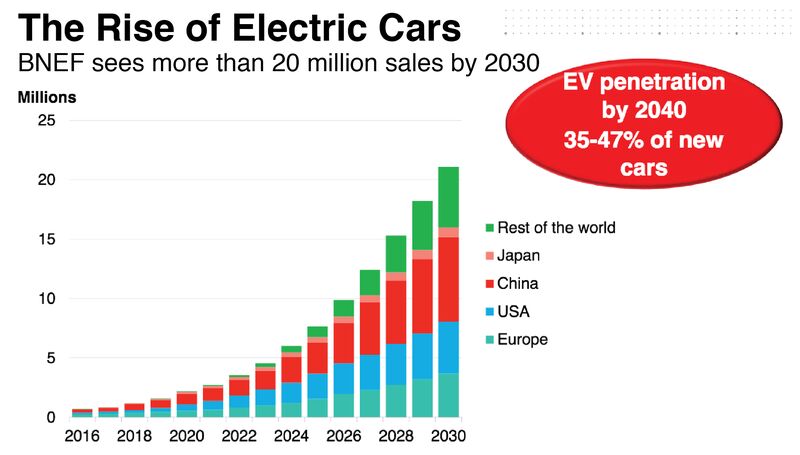
As reported by Bloomberg: Electric cars are coming fast -- and that’s not just the opinion of carmakers anymore. Total SA, one of the world’s biggest oil producers, is now saying EVs may constitute almost a third of new-car sales by the end of the next decade.
The surge in battery powered vehicles will cause demand for oil-based fuels to peak in the 2030s, Total Chief Energy Economist Joel Couse said at Bloomberg New Energy Finance’s conference in New York on Tuesday. EVs will make up 15 percent to 30 percent of new vehicles by 2030, after which fuel “demand will flatten out,” Couse said. “Maybe even decline.”
Couse’s projection for electric cars is the highest yet by a major oil company and exceeds BNEF’s own forecast, said Colin McKerracher, head of advanced transport analysis at Bloomberg New Energy Finance.
“That’s big,” McKerracher said. “That’s by far the most aggressive we’ve seen by any of the majors."
Source: Bloomberg New Energy Finance
Other oil companies have been trimming their long-term forecasts for oil demand. Royal Dutch Shell Plc Chief Executive Officer Ben van Beurden said in March that oil demand may peak in the late 2020s. It set up a business unit to identify the clean technologies where it could be most profitable.
Electric cars are beginning to compete with gasoline models on both price and performance. The most expensive part of an electric car is the battery, which can make up half the total cost, according to BNEF. The first electric cars to be competitive on price have been in the luxury class, led by Tesla Inc.’s Model S, which is now the best-selling large luxury car in the U.S.
But battery prices are dropping by about 20 percent a year, and automakers have been spending billions to electrify their fleets. Volkswagen AG is targeting 25 percent of its sales to be electric by 2025. Toyota Motor Corp. plans to phase out fossil fuels altogether by 2050.
Electric cars currently make up about 1 percent of global vehicle sales, but traditional carmakers are preparing for transformation. In 2018, Volkswagen plows into electrification with an Audi SUV and the first high-speed U.S. charging network to rival Tesla’s Superchargers. Tata Motors Ltd.’s Jaguar and Volvo Cars both have promising cars on the way too, and by 2020, the avalanche really begins, with Mercedes-Benz, VW, General Motors Co. and others releasing dozens of new models.
“By 2020 there will be over 120 different models of EV across the spectrum,” said Michael Liebreich, founder of Bloomberg New Energy Finance. “These are great cars. They will make the internal combustion equivalent look old fashioned.”