the good word groundswell

A Tech Blog on Communications, Energy, Location, Transportation and Logistics.

Search This Blog

Friday, October 28, 2016

How AI Is Shaking Up the Chip Market

As reported by Wired: IN LESS THAN 12 hours, three different people offered to pay me if I’d spend an hour talking to a stranger on the phone.
All three said they’d enjoyed reading an article I’d written about Google building a new computer chip for artificial intelligence, and all three urged me to discuss the story with one of their clients. Each described this client as the manager of a major hedge fund, but wouldn’t say who it was.
The requests came from what are called expert networks—research firms that connect investors with people who can help them understand particular markets and provide a competitive edge (sometimes, it seems, through insider information). These expert networks wanted me to explain how Google’s AI processor would affect the chip market. But first, they wanted me to sign a non-disclosure agreement. I declined.
These unsolicited, extremely specific, high-pressure requests—which arrived about three week ago—underscore the radical changes underway in the enormously lucrative computer chip market, changes driven by the rise of artificial intelligence. Those hedge fund managers see these changes coming, but aren’t quite sure how they’ll play out.
Of course, no one is quite sure how they’ll play out.
Today, Internet giants like Google, Facebook, Microsoft, Amazon, and China’s Baidu are exploring a wide range of chip technologies that can drive AI forward, and the choices they make will shift the fortunes of chipmakers like Intel and nVidia. But at this point, even the computer scientists within those online giants don’t know what the future holds.

Going Deep

These companies run their online services from data centers packed with thousands of servers, each driven by a chip called a central processing unit, or CPU. But as they embrace a form of AI called deep neural networks, these companies are supplementing CPUs with other processors. Neural networks can learn tasks by analyzing vast amounts of data, including everything from identifing faces and objects in photos to translating between languages, and they require more than just CPU power.
And so Google built the Tensor Processing Unit, or TPU. Microsoft is using a processor called a field programmable gate array, or FPGA. Myriad companies employ machines equipped with vast numbers of graphics processing units, or GPUs. And they’re all looking at a new breed of chip that could accelerate AI from inside smartphones and other devices.

Any choice these companies make matters, because their online operations are so vast. They buy and operate far more computer hardware than anyone else on Earth, a gap that will only widen with the continued importance of cloud computing.  If Google chooses one processor over another, it can fundamentally shift the chip industry.
The TPU poses a threat to companies like Intel and nVidia because Google makes this chip itself. But GPUs also play an enormous role within Google and its ilk, and nVidia is the primary manufacturer of these specialized chips. Meanwhile, Intel has inserted itself into the mix by acquiring Altera, the company that sells all those FPGAs to Microsoft. At $16.7 billion, it was Intel’s largest acquisition ever, which underscores just how much the chip market is changing.
Image result for ai chip market

First, Training. Then, Execution

But sorting all this out is difficult—in part because neutral networks operate in two stages. The first is the training stage, where a company like Google trains the neural network to perform a given task, like recognizing faces in photos or translating from one language to another. The second is the execution stage, where people like you and me actually use the neural net—where we, say, post a photo of our high school reunion to Facebook and it automatically tags everyone in it. These two stages are quite different, and each requires a different style of processing.
Today, GPUs are the best option for training. Chipmakers designed GPUs to render images for games and other highly graphical applications, but in recent years, companies like Google discovered these chips can also provide an energy-efficient means of juggling the mind-boggling array of calculations required to train a neural network. This means they can train more neural nets with less hardware. Microsoft AI researcher XD Huang calls GPUs “the real weapon.” Recently, his team completed a system that can recognize certain conversational speech as well as humans, and it took them about a year. Without GPUs, he says, it would have taken five. After Microsoft published a research paper on this system, he opened a bottle of champagne at the home of Jen-Hsun Huang, the CEO of nVidia.
But companies also need chips that can rapidly execute neural networks, a process called inference. Google built the TPU specifically for this. Microsoft uses FPGAs. And Baidu is using GPUs, which aren’t as well suited to inference as they are to training, but can do the job with the right software in place.

To the Smartphone

At the same time, others are building chips to help execute neural networks on smartphones and other devices. IBM is building such a chip, though some wonder how effective it might be. And Intel has agreed to acquire Movidius, a company that is already pushing chips into devices.
Image result for ai chip market Movidius
Intel understands that the market is changing. Four years ago, the chip maker told us it sells more server processors to Google than it sells to all but four other companies—so it sees firsthand how Google and its ilk can shift the chip market. As a result, it’s now placing bets everywhere. Beyond snapping up Altera and Movidius, it has agreed to buy a third AI chip company called Nervana.
That makes sense, because the market is only starting to develop. “We’re now at the precipice of the next big wave of growth,” Intel vice president Jason Waxman recently told me, “and that’s going to be driven by artificial intelligence.” The question is where the wave will take us.
An AI feedback loop annotates 'noise' with ghostly images it's been trained to see.

Posted by Thomas Grounds at 12:17 PM No comments:
Email ThisBlogThis!Share to XShare to FacebookShare to Pinterest

Tuesday, October 25, 2016

Uber's Self-Driving Truck Company Completes a 120-Mile Beer Run

As reported by Engadget: If you're in Colorado and grab a can of Budweiser, it's possible that you might be sipping beer delivered by Uber's autonomous truck company. Today, Otto confirmed that on October 20th, it "completed the world's first shipment by a self-driving truck," a delivery that involved transporting 2,000 cases (or 51,744 cans) of Bud from Fort Collins, Colorado to Colorado Springs along Interstate 25.

Although impressive, this "world first" is mostly promotional. The Verge reports that a human driver first navigated the truck from a Anheuser-Busch depot to a weigh station in Fort Collins. From there, Otto's self-driving technology was deployed and the Volvo big rig drove the remaining 100 miles to Colorado Springs without any outside assistance. Once it entered the city, the driver -- who monitored the journey from the sleeper berth in the back -- resumed control and completed the final maneuvers.

With Uber's self-driving cars taking to US streets and Otto now starting to make its first shipments, the company is finally starting to realize its vision as a logistics company. Right now, deliveries are marketed as a step towards a "safe and productive future" across US highways, allowing drivers to rest while their vehicle does the hard miles. However, with Uber's rapid expansion into cities worldwide, it likely won't be long until it's self-driving trucks can negotiate confusing inter-city streets too.

To mark the Budweiser milestone, Uber is now inviting potential partners to inquire about its haulage offering, which it's now calling Uber Freight. "Our partnership with Anheuser-Busch is just beginning," says the company in a blog post. "Our companies are excited to transform commercial transportation together."

Posted by Thomas Grounds at 10:01 AM No comments:
Email ThisBlogThis!Share to XShare to FacebookShare to Pinterest

Thursday, October 20, 2016

Tesla’s New Autopilot Will Run in ‘Shadow Mode’ to Prove That it’s Safer Than Human Driving

As reported by The Verge: Tesla today rolled out a next-generation version of its autonomous driving hardware suite, which the company says the tech should be able to autonomously drive a Tesla from LA to New York, dropping a rider off in Times Square and then going to park itself.

But, before Teslas can start driving autonomously, the company needs to collect a lot of data to prove to customers (and regulators) that the technology is safe and reliable. So, the car will run Autopilot in “shadow mode” in order for Tesla to gather statistical data to show false positives and false negatives of the software. In shadow mode, the car isn’t taking any action, but it registers when it would have taken action. Then, if the Tesla is in an accident, the company can see if the autonomous mode would have avoided the accident (or the other way around, with the self-driving system potentially causing an accident).

It will record how the car would have acted if the computer was in control, including information about how the car might have avoided an accident (or caused one). That data would then be used to show “a material improvement in the accident rate over manually driven cars,” said Tesla CEO Elon Musk on a call with reporters today. “I think at that point regulators would be comfortable approving it.”
Musk said that he hopes the US will not end up with a patchwork of autonomous regulations across states, noting that the EU appears like it will have a unified standard. He hopes that Tesla’s collection of statistical data regarding potential autonomous vehicle actions — millions of miles across thousands of cars driving in the real world — will help regulators be comfortable enough to sign off on his self-driving vision.
“We look carefully at the regulations and make sure that what we do is in line with those,” Musk said. “We can’t do anything other than that because it would be against the law.”
Tesla also announced it is giving all its new cars the hardware for “full self-driving capabilities,” including 8 cameras with 360-degree viewing at up to 820 feet of distance, as well as 12 ultrasonic sensors that can detect both hard and soft objects. A new forward-facing radar helps see through rain, fog, and dust.
“The full autonomy update will be standard on all Tesla vehicles from here on out,” Musk says.
The updates are included in all new Tesla vehicles built from today forward — however, don’t expect your new Model X to be fully autonomous when you pick it up. Tesla says it needs to “further calibrate the system using millions of miles of real-world driving” before it hands your car fully over to a computer.
On the call about the new hardware, Musk said the hardware is fully capable of “Level 5 autonomy,” a big step forward.
Most significantly, new Teslas won’t have access to some safety features that older Teslas have, including automatic emergency braking, collision warning, lane holding, and active cruise control. The company says that these features will be activated after they are “robustly validated.”
“As always, our over-the-air software updates will keep customers at the forefront of technology and continue to make every Tesla, including those equipped with first-generation Autopilot and earlier cars, more capable over time,” said the Tesla statement.
In essence, it reads as though Tesla has put together a better, more powerful hardware system for these safety and autonomous driving features, but this new system isn’t going to be ready for real use right away. That’s a disappointing dip in the road, but apparently a necessary one.


Musk started off the call with a testy answer - defending Tesla Autopilot and laying into media outlets that don’t put the accidents that have happened from it into the proper context. Autonomous driving is so much safer, Musk argues, that outlets that put too much emphasis on the crash are “killing people.” He then added: “next question.”

Musk says that the “Tesla Neural Net” doesn’t require any third party hardware sensors, and that it’s based on the Nvidia Titan GPU (although it could run on other processors). He says that it’s 40 times more powerful than the last Tesla computer, “it’s basically a supercomputer in a car,” he said. “We go from one camera to eight cameras,” Musk said. Three of them are forward cameras, for redundancy, and the rest provide “360 coverage” for the rest of the car. The new Teslas will also have 360-ultrasonic sonar.

“I think is is very hard to turn into a kit,” Musk said, so it won’t be sold to other car makers. All the cameras and sensors he is talking about won’t cause “weird protuberances” or make the cars look funny.

Musk also promised a demonstration of a fully autonomous drive from Los Angeles to New York by the end of 2017. Musk largely begged off talking about what the regulation would or should be but he did note that the computer will “always be running in ‘shadow mode,’” so that he can build the case that his self-driving software would have been safer than human drivers.


Fully-autonomous Teslas are getting closer to reality. Yesterday, the electric carmaker announced that all new vehicles will come with extra hardware to support "full self-driving capabilities,” and this morning, the company posted a video showing exactly what that hardware can do.

The self-driving software is not finished and has yet to be approved by regulators, but the four-minute clip is nonetheless impressive, showing a Tesla leaving a garage, driving across town, and finding its own parking spot — all autonomously. There is someone sat in the driver's seat, as per current legal requirements, but they never touch the wheel. Tesla CEO Elon Musk, who posted the clip to Twitter, notes that the car is even smart enough to driver past a disabled parking spot, knowing it's not allowed to park there. He also highlighted the car's summon function:
6h
Elon Musk 
✔@elonmusk
When searching for parking, the car reads the signs to see if it is allowed to park there, which is why it skipped the disabled spot

 Follow
Elon Musk 
✔@elonmusk
When you want your car to return, tap Summon on your phone. It will eventually find you even if you are on the other side of the country
2:34 AM - 20 Oct 2016
  •  
  •  3,0883,088 Retweets
  •  
  •  6,0786,078 likes

All of this technology is a long way from being implemented, but it does raise some interesting questions. Like, what happens if you summon a Tesla on your phone while you are moving (say on a train, or in another form of transportation like a taxi) — will the car follow you round indefinitely, or will it only drive to the initial summon location? It's all to come.

Posted by Thomas Grounds at 9:13 AM No comments:
Email ThisBlogThis!Share to XShare to FacebookShare to Pinterest

Wednesday, October 19, 2016

These AI Traffic Lights Could Shorten Your Commute

As reported by Spectrum IEEE: Idling in rush-hour traffic can be mind numbing. It also carries other costs. Traffic congestion costs the U.S. economy $121 billion a year, mostly due to lost productivity, and produces about 25 billion kilograms of carbon dioxide emissions, Carnegie Mellon University professor of robotics Stephen Smith told the audience at a White House Frontiers Conference last week. In urban areas, drivers spend 40 percent of their time idling in traffic, he added.
The big reason is that today’s traffic signals are dumb. Smith is developing smart artificial-intelligence-fueled traffic signals that adapt to changing traffic conditions on the fly. His startup Surtrac is commercializing the technology.
In pilot tests in Pittsburgh, the smart traffic management system has gotten impressive results. It reduced travel time by 25 percent and idling time by over 40 percent. That means less time spent staring out the windshield and more time working, being with your family, or doing anything else. I’m a Pittsburgh resident who has witnessed the city’s rapidly-evolving urban landscape. And I can attest to the mostly frustration-free driving that has resulted from this system despite a the city’s growing population. 
The researchers also estimate that the system cuts emissions by 21 percent. It could also save cities the cost of road-widening or eliminating street parking by boosting traffic throughput.
Conventional traffic lights have preprogrammed timing that’s updated every few years. But as traffic patterns evolve, the systems can fall out of date much more quickly that.
Image result for Surtrac systemThe Surtrac system instead relies on computerized traffic lights coordinating closely with each other. Radar sensors and cameras at each light detect traffic. Sophisticated AI algorithms use that data to build a timing plan “that moves all the vehicles it knows about through the intersection in the most efficient way possible,” Smith says. The computer also sends the data to traffic intersections downstream so they can plan ahead.
Unlike other smart traffic-management systems, such as one used in Los Angeles, Smith emphasized that this one is decentralized. So each signal makes its own timing decisions, making it a truly smart system.
Smith’s team started by implementing the AI traffic control system at nine intersections in Pittsburgh’s busy East Liberty neighborhood in 2012. The network now spans 50 intersections, with plans to expand it city-wide.
The next step is to have traffic signals talk to cars. The Smith’s group has already installed short-range radios at 24 intersections. Such systems are expected to begin being built into some cars in 2017, he said. Traffic signals could then let drivers know of upcoming traffic conditions or let them know lights are about to change, increasing safety and relieving congestion.
A vehicle-to-infrastructure communication system could also prioritize certain vehicles. The CMU team is working with the Pittsburgh Port Authority to develop a system that prioritizes public transport buses.
Pittsburgh is also the test-bed for Uber’s self-driving cars, and Smith’s work on AI-enhanced traffic signals that talk with self-driving cars is paving the way for the ultimately fluid and efficient autonomous intersections.
Image result for Uber self driving cars pittsburgh
Posted by Thomas Grounds at 8:01 AM No comments:
Email ThisBlogThis!Share to XShare to FacebookShare to Pinterest

Tuesday, October 18, 2016

Millimeter-Wave 5G Modems Coming Mid-2018 with 5Gbps Peak Download

As reported by ArsTechnica: Qualcomm is promising to launch its first 5G modem in 2018, even though basic standards for 5G have yet to be established, nor even which part of the radio spectrum it will use.
Dubbed the Snapdragon X50, the San Diego chipmaker says its new modem will be able to deliver blindingly fast peak download speeds of around 5Gbps.
The X50 5G will at first operate with a bandwidth of about 800MHz on the 28GHz millimetre wave (mmWave in Qualcomm jargon) spectrum, a frequency that's also being investigated by Samsung, Nokia, and Verizon. However, the powers that be have far from settled on this area of the spectrum, with 73GHz also being mooted. In the UK, Ofcom is investigating several bands in a range between 6GHz and 100GHz. As the industry as a whole is a long way from consensus, this could be Qualcomm's bid to get the final frequency locked down well before 2020—the year that 5G is expected to reach any kind of consumer penetration.
"The Snapdragon X50 5G modem heralds the arrival of 5G as operators and OEMs reach the cellular network and device testing phase," said Qualcomm exec veep Cristiano Amon. "Utilising our long history of LTE and Wi-Fi leadership, we are thrilled to deliver a product that will help play a critical role in bringing 5G devices and networks to reality. This shows that we’re not just talking about 5G, we’re truly committed to it.”
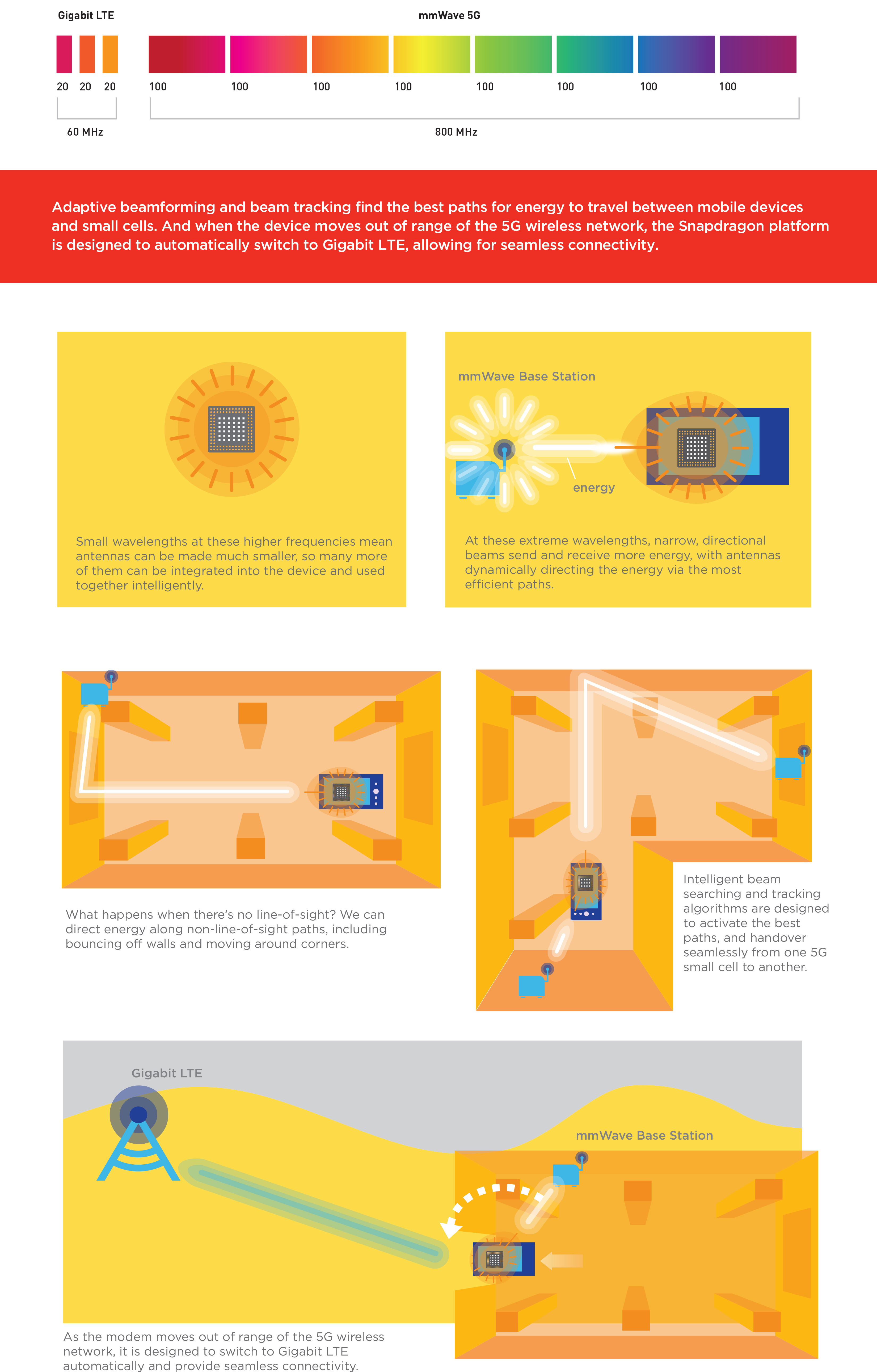
A rather cutesy infographic from Qualcomm on how millimetre-wave cell networks might operate. Click to zoom in.

The modem, which Qualcomm stresses is designed to aid early trials for manufacturers and operators, can switch back down to 4G LTE if a 5G cell can't be found, which is just as well, as millimetre-wave frequencies often struggle to penetrate solid and semi-solid objects.  Qualcomm's offering seems to be to increase the number of base stations (small cells), and then use lots of Multiple-Input Multiple-Output (MIMO) antennas. It said:
"Years of research and development have allowed us to invent technologies to overcome mmWave’s limitations. Instead of using only a handful of antennas (as with 4G), the Snapdragon X50 5G modem relies on multi-element antenna arrays. The antennas are designed to work together intelligently, using beamforming and beam tracking technologies, extending mmWave’s mobility and reach to non-line-of-sight scenarios. For example, the Snapdragon X50 5G modem can direct the energy of the mmWave beam, bouncing off obstacles to reach the mmWave 5G small cell with which it is communicating."
At the same time, the firm also revealed its next generation of Snapdragon chips on the first day of its 4G/5G Summit in Hong Kong. The three new processors, dubbed Snapdragon 653, 626, and 427, will supersede its current 652, 625, and 425 chips. All three chips are strictly pitched at mid-range solutions—there was no new reveal in its high-end 800 series, but all three apparently have support for several key new features.
Firstly, the chips integrate Qualcomm's newer X9 LTE modem, which it says allows Cat 7 downlink speeds of up to 300Mbps, and Cat 13 uplink speeds reaching 150Mbps—a 50 percent increase in maximum uplink speed over its previous X8 model. Dual-camera support—branded Clear Sight technology— taken from the 800 series is also included in the new chips, while the new Quick Charge 3.0 could deliver four times the charging speeds. The 653 also sees a significant memory upgrade, with its RAM doubled from 4GB to 8GB.
The 653 and 626 chipsets should be commercially available by the end of the year, while the 427 is planned to be slotted into consumer devices in early 2017.

Posted by Thomas Grounds at 9:25 AM No comments:
Email ThisBlogThis!Share to XShare to FacebookShare to Pinterest

Thursday, October 13, 2016

BMW's Motorcycle of the Future Doesn't Require a Helmet

As reported by Engadget: BMW has unveiled a slew of concept vehicles to mark its 100th birthday, but its fourth and last example might be the most daring. Its new Motorrad Vision Next 100 concept motorcycle would supposedly be so smart that you wouldn't need a helmet, or even a padded suit. The key would be a self-balancing system that keeps the bike upright whether or not you're moving -- newcomers wouldn't have to worry about toppling over, and veterans could push limits further than usual.

Also, notice the absence of the usual space for an instrument cluster? That's because you wouldn't need it. Most information would instead display through a smart visor that shows data as it becomes relevant. All told, you'd spend more time enjoying open air driving and less time worrying about your speed or range (BMW will only say that this is a "zero-emission" bike, but it'd likely be electric).

Like the other Vision Next 100 concepts, you're not going to see this exact motorcycle on the road any time soon. However, it might not just be due to the grand technological ambitions. While a self-balancing system could prevent you from crashing the bike yourself, it wouldn't protect you in many serious collisions. What if you're forcefully ejected from your vehicle? Regulators would likely require some kind of helmet, even if it's not as cumbersome as what you wear today.


Posted by Thomas Grounds at 10:34 AM No comments:
Email ThisBlogThis!Share to XShare to FacebookShare to Pinterest

Monday, October 10, 2016

Germany Calls for a Ban on Combustion Engine Cars by 2030

As reported by Engadget: Germany isn't content with relying on financial incentives to usher in an era of pollution-free cars. The country's Bundesrat (federal council) has passed a resolution calling for a ban on new internal combustion engine cars by 2030. From then on, you'd have to buy a zero-emissions vehicle, whether it's electric or running on a hydrogen fuel cell. This isn't legally binding, but the Bundesrat is asking the European Commission to implement the ban across the European Union... and when German regulations tend to shape EU policy, there's a chance that might happen.

The council also wants the European Commission to review its taxation policies and their effect on the "stimulation of emission-free mobility." Just what that means isn't clear. It could involve stronger tax incentives for buying zero-emissions cars, but it could also involve eliminating tax breaks for diesel cars in EU states. Automakers are already worried that tougher emission standards could kill diesels -- remove the low cost of ownership and it'd only hasten their demise.

Not that the public would necessarily be worried. Forbes notes that registrations of diesels, still mainstays of the European car market, dropped sharply in numerous EU countries in August. There's a real possibility that Volkswagen's emission cheating scandal is having a delayed effect on diesel sales. Combine that with larger zero-emissions incentives and the proposed combustion engine ban, and it might not take much for Europeans to go with electric or hydrogen the next time they go car shopping.


Posted by Thomas Grounds at 10:14 AM No comments:
Email ThisBlogThis!Share to XShare to FacebookShare to Pinterest
Newer Posts Older Posts Home
View mobile version
Subscribe to: Comments (Atom)

iTRAK Corporation - Fleet, Asset and Smartphone Tracking Telematics Systems and Solutions

  • iTRAK Corporation Web Site

The Good Word Groundswell is on Flipboard too!

  • Flipboard - The Good News Groundswell

Translate

Blog Archive

  • ▼  2022 (10)
    • ▼  August (1)
      • Did Russia Just Launch a Spacecraft to Stalk a US ...
    • ►  June (1)
    • ►  May (2)
    • ►  April (2)
    • ►  February (3)
    • ►  January (1)
  • ►  2021 (14)
    • ►  December (2)
    • ►  November (1)
    • ►  August (2)
    • ►  June (1)
    • ►  May (2)
    • ►  April (2)
    • ►  March (1)
    • ►  February (1)
    • ►  January (2)
  • ►  2020 (31)
    • ►  December (1)
    • ►  November (3)
    • ►  October (4)
    • ►  September (2)
    • ►  August (8)
    • ►  June (1)
    • ►  May (2)
    • ►  April (2)
    • ►  March (1)
    • ►  February (4)
    • ►  January (3)
  • ►  2019 (21)
    • ►  December (2)
    • ►  November (1)
    • ►  September (3)
    • ►  July (4)
    • ►  June (7)
    • ►  May (1)
    • ►  April (1)
    • ►  January (2)
  • ►  2018 (22)
    • ►  October (4)
    • ►  June (5)
    • ►  February (5)
    • ►  January (8)
  • ►  2017 (138)
    • ►  December (8)
    • ►  November (18)
    • ►  October (20)
    • ►  September (15)
    • ►  August (16)
    • ►  July (16)
    • ►  June (12)
    • ►  May (5)
    • ►  April (8)
    • ►  March (9)
    • ►  February (3)
    • ►  January (8)
  • ►  2016 (172)
    • ►  December (6)
    • ►  November (5)
    • ►  October (11)
    • ►  September (8)
    • ►  August (13)
    • ►  July (12)
    • ►  June (23)
    • ►  May (20)
    • ►  April (11)
    • ►  March (17)
    • ►  February (22)
    • ►  January (24)
  • ►  2015 (420)
    • ►  December (25)
    • ►  November (26)
    • ►  October (40)
    • ►  September (22)
    • ►  August (32)
    • ►  July (41)
    • ►  June (40)
    • ►  May (30)
    • ►  April (36)
    • ►  March (45)
    • ►  February (36)
    • ►  January (47)
  • ►  2014 (503)
    • ►  December (33)
    • ►  November (27)
    • ►  October (27)
    • ►  September (23)
    • ►  August (46)
    • ►  July (35)
    • ►  June (35)
    • ►  May (66)
    • ►  April (59)
    • ►  March (52)
    • ►  February (45)
    • ►  January (55)
  • ►  2013 (376)
    • ►  December (44)
    • ►  November (37)
    • ►  October (44)
    • ►  September (96)
    • ►  August (81)
    • ►  July (37)
    • ►  June (23)
    • ►  May (14)

About Me

Thomas Grounds
View my complete profile
  • iTRAK Facebook
  • iTRAK Linked-In
  • iTRAK YouTube
  • iTRAK Corporation
  • Tom's Twitter
  • Tom's Linked-In
  • Tom's Google+ site
Awesome Inc. theme. Theme images by Dizzo. Powered by Blogger.